Monday, October 28, 2013

The Annual Summer Lodge Post

Well, I'm doing this post about two and a half months after actually taking most of the pictures on our annual summer vacation up north with my wife's family.  I'm getting further behind and taking less pictures than ever these days! Oh well...

One of the first things I do when we get there, well birding wise anyway, is to listen and look for the Merlins which nest and raise young every year on the opposite edge of lake where my in-law's cottage is.  Last year I noticed, with significant chagrin that the new owners of the cottage with the big old white pine tree which hosted the Merlin nest had been cut down.  I wondered if this year they'd still be around.  I was happy to notice them quite soon, and even more pleased that they seem to be spending more time on "our" side of the lake.  In the morning one day, one of the young ones spent a few moments in a snag not far from our beach.  It tolerated me for long enough to get a couple picture from a bad angle below, and headed out with its trademark "kalee kalee" call.

juvenile Merlin against blue sky.

My dear wife is agreeable to me heading out for a good chunk of a day that week, and I made a circuit of a few spots I've started to have success with over the years.  Tait Lake almost always gives good views of a Loon pair that nests there yearly.  I wasn't disappointed this trip either. 

Common Loon on Tait Lake

Common Loon

Common Loon

I only got one short bit of time though with some close up shots and the loon decided I was not good company and dove to a more distant section of the lake. While wandering around after, the calm morning water doubled the presence of some Mallard females.  They were different sizes, so I wonder if some were juveniles that hatched early in the spring and gotten all their adult plumage already.

female Mallard ducks

As I stood along the bank, I noticed something foraging right along the water's edge, hidden by the foilage growing in a short little undercut the water had made in the sandy bank.  At first I didn't really pay it much attention, but as it continued slowly along, I got curious, for some reason expecting it to be a Starling or something of that sort.  But as I approached, I saw it wasn't a bird at all.  Two black little beady eyes met mine on a dark furry face that froze as I did.  We both looked at each other wondering what would be next.  I knew if I moved it would be gone, but longed to get my camera up.  The weasel moved first and dove into the water for a getaway.  I had to clear some scrub and by the time I got my camera on it, it had made a surprising amount of headway meaning more distant picture. 

Weasel swimming across the lake.

A new mammal on the animal list though!  Because I didn't get more than a partially hidden view on land, and only the view of a wet back in the water, I can't say which of the two larger, darker species it was.  We have three weasels here in Southern Ontario, but I believe it was either a Long-tailed or Short-tailed Weasel. It was too dark and large to be a Least Weasel.

I headed on to Eagle's Nest to walk the Christie Trail loop. (I recently found a better link to a map for the park)  I didn't see a lot this time, but still got a few pictures. My first sighting along the trail to the Hawk Lookout was a Flicker.  Usually, you hear their scolding call first before you have a chance to see them.  However, this one seemed to eye me carefully first, let me take a partially impaired photo, and then beat a noisy retreat.

Yellow-shafted Northern Flicker

A teasing Hermit Thrush stayed just a head of me as headed to the Christie Trail and gave me only a few chances for an partial view for a picture.

Hermit Thrush

As I finished the walk along the trail which winds through the lower elevations and more open forest, a White-breasted Nuthatch was foraging along the tree bark and caught a caterpillar for a meal.

White-breasted Nuthatch

White-breasted Nuthatch

On my way back to the lodge, I stopped one more time at Tait Lake and this time both the loons were back in the small bay by the road.  I stopped and flushed one of the loons into the air as I got out.  That is strange as their preferred method is to dive as they do not get airborne easily. It made a long, running takeoff necessary to get this water loving bird out of the water.  They are actually very fast flyers, reaching speeds faster than most birds, but they need a very long takeoff to get into the air, "running" on the water's top for quite a ways to aid in gaining speed.  The first loon circled back over me again and I managed to get one half decent shot as it zipped by.

Common Loon fly by.

Not long after its mate took off, the other decided to follow suit, too quick for me to change my camera settings leaving me with only a few salvageable shots.

Common Loon takeoff

Common Loon takeoff

Common Loon take off

Although quite blurry, I kind of like this shot from right at the beginning of the takeoff.

Common Loon takeoff

Back at the Lodge there were other sights to see too.  Almost every summer, we experience one night when there is a emerging of flying ants.  They dig out of their underground habitations and take wing.  There to capitalize on the event are hundreds of dragon flies.  It's quite a sight.  Some years are more intense than others, and this year the numbers were not quite as big as other years.

Flying ants emerging and taking to the skies.

A nephew and I rigged a net and caught of few of the dragonflies to look at up close.


Dragonfly
Dragonfly
Dragonfly

Other insects inhabit the lodge grounds as well... I couldn't determine what type of grasshopper this was.

Grasshopper species.

A new butterfly landed just long enough to let me take a blurry picture while it took a quick "sip" from the sand.  I also could not tell what type it was for sure.  It think it is a Duskywing Butterfly.  Dwayne, do you know which one it is?

Juvenal's Duskywing Butterly (thanks Dwayne!)

Later that week, visiting our former Pastor and his wife who were vacationing on the opposite side of the lake the same week, I spotted one of the Merlin again. 

Merlin

Merlin

Don't hold your breath till the next post... my track record would prove to put you on the floor passed out.  But we'll see if I can't close the gap a bit.

Till then...
Keep enjoying HIS handiwork!


Sunday, October 6, 2013

The Other Side of the Pond

Nope, I didn't make a birding trip to Europe.  I simply walked to the other side of the pond.  Almost every time I got to Valley Inn Road ponds, I make my way towards the walking path which heads along the Grindstone Creek.  Good intentions to visit "the other side" are usually unfulfilled by the time I'm realizing lunch hour is going to be over and I better head back to the car and office. But this time I decided finally go to the rarely visited side where there is some good habitat for herons.  I had been told by others as well that they were often found there.

Just before heading to the water's edge, there is a small trail feature which has wild flowers along the edges.  I found a Hummingbird Moth feeding there.

Hummingbird Moth

Hummingbird Moth

I walked along the pond edge and looked through and along the cover of the green growth spilling over the banks - perfect habitat for Nigh Herons which like to perch there.  I didn't see anything and enjoyed just waiting quietly to see what might come by.

Caspian Tern

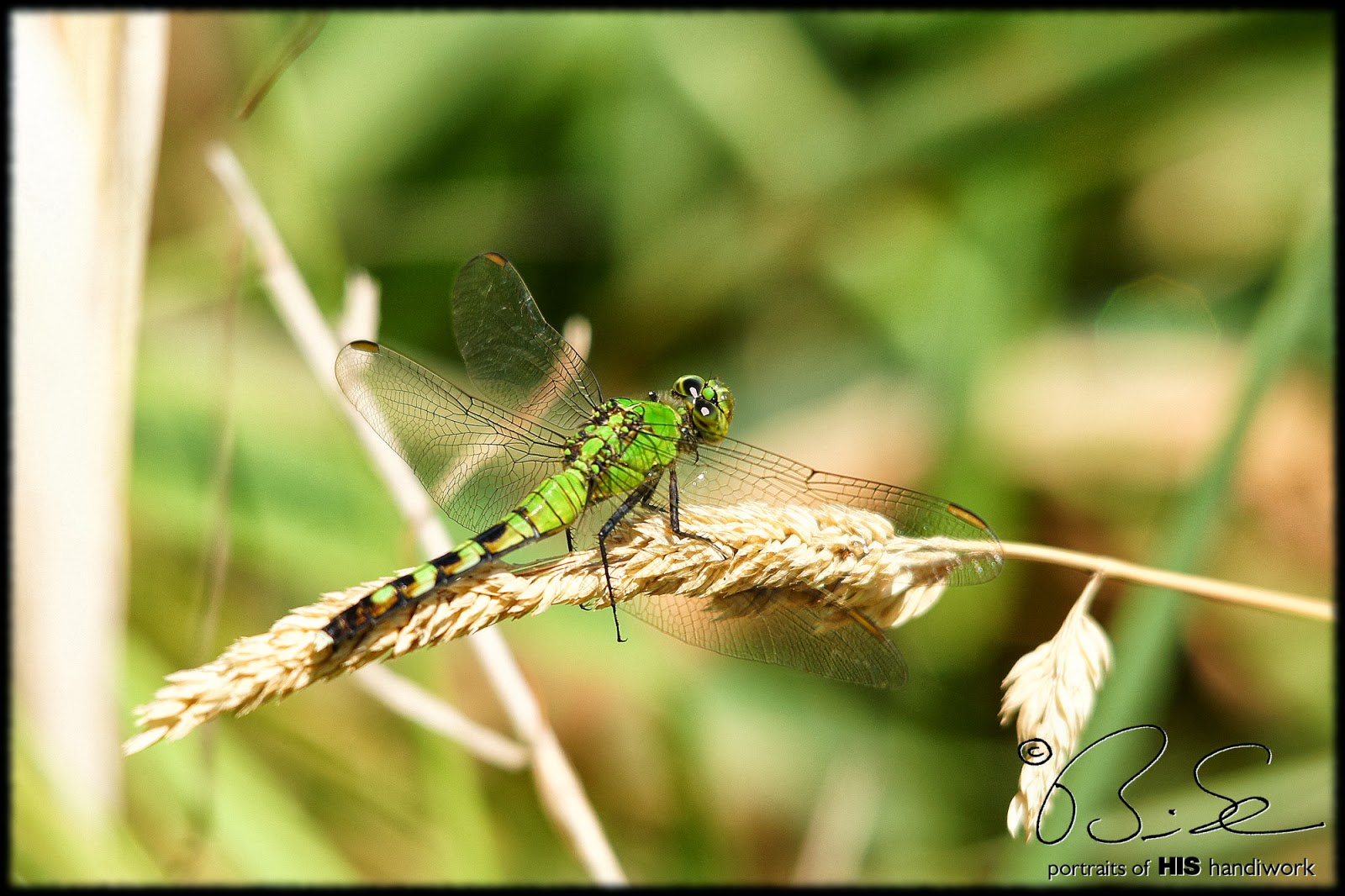
A dragonfly also popped by to visit while I waited.

Eastern Pondhawk

Then out of the corner of my eye, I caught movement in the shadows, and maybe after a nap, a juvenile Black-crowned Night Heron made an appearance, balancing on a fallen branch.  It settled in the shelter of the

juvenile Black-crowned Night Heron


The first year bird was going after bugs on the top of the water, and at one attempt to retrieve something on the top of the water, slipped off the branch and fell in the water.  Good thing there was no snapping turtle lurking under the duck weed.


juvenile Black-crowned Night Heron spill into the pond.


Alert juvenile Black-crowned Night Heron.

On the way home from work that day, I was able to capture the Wild Turkeys I often see in the morning or evening.  They are hard to get close to though.  They seem completely oblivious when the cars are driving by, but walking even quietly and seeming under cover of ditch and hedge lines doesn't seem to cut. They have excellent vision as well as hearing and are quite cautious birds.  Once they notice you, they start moving quickly.

Wild Turkeys

Wild Turkey wing stretch
Wild Turkeys heading for the cover of the bush.


Till next time,
Keep enjoying HIS handiwork.

Sunday, September 29, 2013

Catching up from the Summer - Valley Inn Road

I'm home from church with JoyAnna who is wrapping up her chicken pox experience, and thought I'd try and catch up on post from this summer.  I've been making fewer and fewer lunch outings these days. Possibly laziness, but maybe also a bit of needing to find a couple new spots to visit.  Though this time I went back to a often visited location, Valley Inn Road, to see if there were any signs of the Northern Flicker fledglings.

When I headed to the nest hole I had found earlier in the spring, there was no sign of the birds.  However, through a gap in the trees there, I could see a Great Blue Heron which had landed down in the Grind Stone Creek ponds.

Great Blue Heron

After landing, it had plumped up its feathers and was displaying its breeding plumage, wispy feathers on its back, breast and back of its head.  The next shot shows how tightly it can compress its feathers to minimize its profile while hunting.

Great Blue Heron

More recently I saw a bird at this same location and with help, got a pretty firm ID as a Warbling Vireo.  I briefly saw a bird with similar characteristics again in roughly the location that day and got two pictures.  I'm pretty sure it's the Warbling Vireo again.  The black tip on the beak, hints of the markings by the eyes contributed to my tentative ID.  I'm hoping for a good view and some clear pictures some day.

poor views of a Warbling Vireo??

I headed a bit further along the trail from the Flicker nest and walked down to the Grindstone Creek bank.  As I approached I flushed what was probably one of the adults from the nest and it warily eyed me from a sapling across the water.

Northern Flicker
 
As I turned around and walked back along the trail, the familiar song of the Carolina Wren let me know a little bird would be perched on a prominent branch out in open somewhere, head thrown back and its little beak wide open singing the tune God gave it to boast.  It was.

Carolina Wren

The treat of the afternoon though was a little fledgling, alone on a branch of a dead tree, that was fluttering and periodically chirping away a call for attention in the way of food.  I didn't have to wait long for the parent to come, bringing a meal fit for a young Tree Swallow.  These two series are the result of a number of attempts to get on the right side of the action and the mid day sun.


Tree Swallow fledgling anticipating a meal.

Tree Swallow fledgling and parent.

 
Tree Swallow fledgling and parent.
 
Tree Swallow fledgling and parent.


I was also trying out the RAW file format on my camera.  I'm glad I did for this series, as the JPG pictures were somewhat over exposed.  Recording in RAW means there is more data recorded without the compression and "finalization" done for the JPG file format.  However, it means there is more noise in the pictures as the camera also automatically does its own noise reduction before finalizing the JPG file.  Amazing what all goes on in the little machine that clicks away, processes and records reams of data in split seconds. But as I've mentioned before, it begs that we notice the meager comparison to the amazing gift of sight, comprehension, decision abilities we've been created with.  Scientists are only coming close to just replicating the type of processing power simple neuron networks have.  And our brains contain more than 100 billion.


Tree Swallow fledgling.

Tree Swallow fledgling being fed.

Tree Swallow fledgling being fed.

Tree Swallow fledgling being fed.


Tree Swallow fledgling being fed.


By the time I had to go, this little guy was still sitting there awaiting the next load of freshly caught bugs.

Tree Swallow fledgling.

It is now later in the evening and I'll finish this post and head to bed to ready myself for another week of work.

Till next time,
Keep enjoying HIS handiwork.


Saturday, September 28, 2013

Sunday Evening at Grass Lake

A warm Sunday evening... sounds nice, especially talking about it as we approach the cooler weather of fall.  Fall is actually my favourite season, but warm summer nights are great too.

With a reasonable amount of light left in a July night, I headed to Grass Lake for an evening outing.  I've only ever been there between services on Sundays and was very interested to see what the lighting and creature activity would be like at that hour.  I met a couple who have been driving there many a Sunday evening, setting out their lawn chairs, and with their backs to the sun enjoying the scene and sounds .  I can see why they say they have missed few weekly evening visits.

There wasn't really any activity at the water, so I headed up the road to the grassy field and saw this Savannah Sparrow nicely lit in the evening light.

Savannah Sparrow

Savannah Sparrow


Savannah Sparrow

Heading back towards the lake, a pair of Eastern Kingbirds were patrolling the warm evening air busily catching the many insects that were circling higher up in the sky.  The Kingbirds were efficiently launching from one tree which had a dead portion and with repeated success capturing what seemed like large flying beetles or something similar.


Eastern Kingbird pair

Eastern Kingbird

Eastern Kingbird
 
Eastern Kingbird

Eastern Kingbird with dragonfly catch.

 
Eastern Kingbird pair in the orange glow of evening sunlight.


I was able to get quite close to the pair as they kept returning to the same tree.  A section of dead branches reached to the evening sky, while the healthy portion of the tree below apparently was host to new life.  I guess after a while they trusted me and betrayed the location of their nest that until then, unaware to me was right ahead.  That was a nice surprise.  With the fading light, I was able to get a few pictures with my ISO setting maxed out as far as I dared and shutter speed set low enough to make me hope my hands would hold steady.  The nest was up high enough that I wished I could gain a couple feet of better viewing angle.  I realized my sunroof might let me stand in the car and get a better view.  I backed up the car, leaving a comfortable distance and popped up through the car roof.  Soon a realized with socked feet, it would be even better just standing on the roof.


Eastern Kingbird chicks

Eastern Kingbird chicks hear a parent approaching.

Eastern Kingbird chicks being fed.
While I was photographing the Kingbirds, I heard the consistent flapping of wings across the roadway.  Looking over I saw three Mourning Doves a top of the fence and one was constantly "pestering" one or the other.  Being so late in the summer, I'm not sure if they would still be courting for another brood anymore?  They do have a number of broods a summer, so I guess it is possible.


Mourning Doves

As the sun set to the west, the moon was rising in the south and I quickly captured the overlap of the birds and the second light that was created to shine on this world.


Eastern Kingbird against the rising moon.

Eastern Kingbird silhouetted against the moon.

As I drove home for the night, a glance over the field yielded my eye just catching sight of someone eying me as I drove by.

White-tailed Deer

White-tailed Deer
White-tailed Deer

Till next summer arrives, we'll enjoy the crisp temperatures, beautiful colours, and crunching sounds of fall.

Keep enjoying HIS handiwork!