Showing posts with label House Wren. Show all posts

Saturday, October 4, 2014

A Compressed Post

No, I did not migrate early and disappear, but I've no hardly bird watched, done any blogging, or much else for that matter in he last couple months. That isn't completely true, but my life has become quite busy and unfortunately a bit unsettled at work in the last few months. We're in a re-building stage at the moment and that means more of my time, focus and energy has had to be directed there. I'm hoping it will only be for a season (both metaphorically speaking and literally).

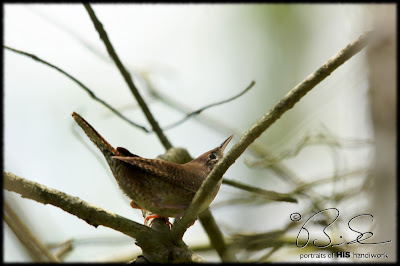
This summer I had the fun of bumping into a family of House Wrens around our place during late summer.  They've nested somewhere nearby and I kept hearing their scolding call, primarily in the evenings, and in our hedge and in the church gardens behind us.  I finally got found the fledglings in the gardens one afternoon and got a few pictures.

Fledgling House Wren

Adult House Wren keeping close eye on me.

Fledgling House Wren

While visiting a great older couple in our church for supper one night, I also got a few minute to take a few low light pictures in the evening light of some of the residents of the many bird houses they have around their property... again House Wrens.  These young ones were not as old as they had not fledged yet.

House Wren with food.

Perturbed House Wren

It finally trusted me and fed its young.

One Sunday afternoon I quickly called my brother after church and we met for a walk at Sudden Tract trail.  We saw pretty much nothing there.  It was strangely quiet except or the many many mosquitoes - we were glad for a very generous couple who actually just gave us their bottle of repellent as they left.  We were not far from Grass Lake and decided to stop there.  Glad we did as someone else alerted us to a pair of Sandhill Cranes feeding in a nearby field with a mature colt.  We were able to walk into the soy bean field and get very close for some pictures.  We were surprised at how tolerant they were of us!

Sandhill Crane family

brother Dan.
Sandhill Crane colt in the soy beans.

adult Sandhill Crane checking me out.
Sandhill Crane colt.

Eye nicitating membrane - translation: protective eye membrane.

Sandhill Crane profile shot.

While working around the yard at home some time later, a young/small Mourning Dove flew and crash landed in the front yard.  I really have no idea where it came from, nor the circumstances, it was not acting normally.  Any approach was met with a delayed and very short, incomplete flights with the same ungraceful crash landing.  It seemed strange given its size and fully feathered condition - it didn't seem like a recent fledgling just learning to fly.  It was trembling and twitching quite uncontrollably though.  I finally picked it up and it perched wobbly on my hand for a while.

Mourning Dove


It eventually did fly away with a lot of encouragement and a few more botched departures.

Well, that catches me up for all but my annual Lodge vacation post which I hope to get to some time - don't hold your breath though! I believe I've used that phrase a number of times in this blog, with greater frequency lately!  Oh well, a time and season for everything.

Till next time...
Keep enjoying HIS handiwork.

Sunday, July 20, 2014

Grass Lake and West Shore of Hamilton Harbour

The very first day of June was a Sunday and I went to Grass Lake for a quiet afternoon. I started out walking on the south side of the 570 AM antenna field where five huge metal spires send the radio signal at the KW Cambridge area.  I met one of the technicians there one evening last summer and chatted with him for hours into the darkness. It was a very interesting chat as he explained lots of the technical information about the antennas and system. The first two (southern) towers actually cancel out background signals, the middle one sends out the radio signal, and then the last two (northern) towers repeat and boost the signal.

Being early afternoon, there wasn't a lot of bird activity, but a Tree Swallow perched for a picture for me not far from its nest box in the radio field.

male Tree Swallow

There were a few pairs of Bobolinks flying around, but not as many as I've seen in the past. I hope that's only because they were all attending nests or young.  But I finally saw as well as got a half decent photo of a female. I'd only ever seen the males before. I still love hearing the completely unique call of these birds. It is such a un-birdlike sound. I've noticed recently though, that Red-winged Blackbirds share slightly in that very different sound characteristic. Has anyone else noticed or heard it too?

female Bobolink

Along the same fence line, you are always sure to see some of the Savannah Sparrow pairs.  They, of all the birds in this area will allow you to get closest.  Moving slowly but surely, they often let me get quite close. It's interesting how different birds characteristically allow approximately the same distance until they are no longer comfortable with your approach.

Savannah Sparrow

Walking towards Grass Lake, a House wren was signing heartily in a small patch of mostly dead Pine Trees.

House Wren

As I walked along the dirt road which sweeps around the water's edge of the shallow, grassy lake, a pair of Sandhill Cranes quietly glided in. I was too slow on the draw and missed getting any pictures.  They landed quite far back in where the deeper, open water is and proceeded to make their presence known to the rest of the lake with their loud calls and comical head movements.

distant Sandhill Cranes

I got startled as I walked along the road edge when suddenly, something large enough to move a significant amount of the long grass at the top of the bank moved quickly towards the water's edge.  The creature turned out to be a large snapping turtle and made a mad slide down the bank, crashing into small trees and branches as it headed for the cover of the water. I went back to the spot and noticed a circular track it had made in the grass with an untouched area of grass left in the middle about a foot and half in diameter. Being early June, it's possible it was looking for a nest site, though it didn't seem like a prime location given a hard packed gravel shoulder with grass roots reinforcing it all.  Then again, those stocky legs and sharp claws would likely suit that task well.

I had heard that there was a Brown Thrasher nesting on the north west end of the lake, but saw no sign of the nest nor the bird. I headed home and decided to leave the opposite directly I usually do, and though not intentionally, past the supposed Thrasher location.  Just as I passed, a big Brown Thrasher flew right in front of me and swept up and landed in a dead tree.  Quickly stopping and trying to get my window down and camera up and ready was too long for the bird to get wary and it flew. I got out and after some searching finally found it way up in a big tree.  I climbed a bank for a better view and still got some nice pictures of life bird #204.

Brown Thrasher

Later that week, I headed out early in the morning before work to the east shore of Hamilton Harbour close 1to the Canadian Centre for Inland Waters on the west side of the QEW.  There had been reports of American Pelicans regularly visiting the man made islands for a number of days and I thought I'd see if I could get some pictures in the early morning sun. Turns out I waited too long and they were not reported again.  But I got to see the large colony of Caspian Terns nesting there mixed among the Ring-billed Gulls doing the same.  You can just make out the fuzzy, well camouflaged young of both species in the pictures.  I'm not sure what the Tern in the middle was doing. It had caught a nice little fish, but was just standing in the same spot for quite a while.  I'm surprised it was not attacked by the other birds around it and either forced to down it quickly, fly away to protect his catch, or drop it and flee. But none of those things happened and I'm not sure what it was waiting for.

nesting Caspian Terns and Ring-billed Gulls

Sharing the same island, but perched on the trees that are barely surviving the acidic anointing they are receiving are the Double-crested Cormorants also attending to young.

nesting Double-crested Cormorant
I was standing on a narrow beach that was just beside a flight path where, over and over again, Cormorants were swooping down from just crossing the QEW bridge for a short, low approach over the water to the island. Many were still bringing nesting material and after many pictures I finally got a half decent one.

Double-crested Cormorant with nesting material

Until next time...
Keep enjoying HIS handiwork!

Saturday, July 27, 2013

Jacob's Woods, St. George

A couple Sundays ago, in the couple hours between church services, I went for a quick walk through the local green space area in St. George.  It's a patch of forest with two different section: a mix of older, more traditional forest of pines and deciduous, and as section of slowly maturing, planted white pines.  Unfortunately, it has never really yielded much in the way of bird life in the times I've walked through it.  This time however, I heard a House Wren chattering its scattered song.  I saw it flitting around me in the trees, checking out who the intruder was in it's territory, but it was too quick for any pictures.

I did see a few butterflies moving about though.  A new butterfly, the Gray Eastern Comma (thanks for the correction Dwayne) was one of them.

Gray Eastern Comma

Gray Eastern Comma.
(the sun just nicely came out as it opened its wings)

Norther Pearly-Eye

With the lack of activity, I soon headed up the ridge to behind the cemetry where someone has been maintaining a few mown trails through a young aspen forest.  It's a neat forest; the trees are all reaching for the light and there is no brush under cover.  At eye level, the view is pretty clear, the only bottom vegetation lower down a thicket of wild raspberry and goldenrod, providing plenty of food for birds that prefer "emergent cover".  Soon enough, I heard the scolding sound of the House Wren again.  The trail I was on was on the top of the ridge, the bottom of which was approximately where I had seen the wren before. So it's quite likely it was the same bird and I was still in its territory.  This time I could see it with more light and clear views.


House Wren

House Wren in classic wren pose.

Soon, I recognized the song of an Indigo Bunting (I'm starting to learn some more bird songs which is helpful).  It was too shy for pictures though. As I came out of the woods and passed a small brush pile from the cemetery, I heard a stern warning "buzz" of a worried little bird and I soon saw a flash of bright yellow and white and black meandering through the tangle of twigs and sticks.  A Common Yellowthroat, life bird #130.


Common Yellowthroat on the edge of a brush pile.
 
Common Yellowthroat
 
With a bird name containing the word "common" you almost feel guilty if you've not noticed them more before.  Checking in the Birds of Hamilton (we're in the Hamilton Bird Study area), the frequency charts do show them as common, but not abundant like Robins, etc.  The Common Yellowthroat's tendency for low, dense underbrush and nesting in a brush pile like I found this one would contribute to them not being easily, or often seen.  A very cute little bird.


Common Yellowthroat

Common Yellowthroat


As I headed home through the cemetery, I noticed a Chipmunk hole with the remnants of harvesting the the meat from walnuts. Someone is busy preparing for winter! The kids call the walnut shell halves "pig noses."

Chipmunk hole and walnut shells.

In the golden rod along the way home, I noticed two busy flies. Not sure what they are.

Two busy flies.


There is an old, abandoned (I think) tree nursery of some sort on the edge of town, and my walk home brought me through there.  In one spruce tree, there was a whole group of both male and female House Finches.

House Finches

A nice Sunday walk!
Till next time.... Keep enjoying His handiwork!


Tuesday, June 11, 2013

Ignoring Close to Home

It's weird that somehow it always seems more exciting to try and bird somewhere a distance away from your own backyard. And although birding in the Hamilton area is well documented to be very productive, it doesn't mean there is nothing close to home to see and enjoy. Over the last few weeks there have been more than one occasion for that to be true.  There was my recent trip to a nearby farm which started as a firewood acquisition.  And the next opportunity also resulted because of getting more firewood.

I was on the south side of St. George cutting and lugging home a few cords from a huge, old Beech tree which the hydro company had taken down in a big wire protection campaign they did in the area.  While feeding the thirsty chainsaw or filling the trailer with wood, consistently I was hearing a persistent, unfamiliar bird call.  On my last load, I brought the camera with me and decided to push into the neighbouring woods which also backs on to an adjacent golf course.  But before I could circle in on the source, I heard and then spotted a Eastern Wood-Pewee.  Their distinctive "PEE-ah-WEE" call gives them away, but they are small and like the tree tops, so I've not gotten a close look before. This one seemed curious about me, so although not really close, I could get a nice look and some closer shots.

Eastern Wood-Pewee

Eastern Wood-Pewee

Ironically, my circling in on the original singer lead me back to where I started, and I finally found the little creature who had been singing along with my chainsaw all day.  It was a cute little House Wren (life bird #124 - I skipped this one).  Unfortunately my vantage of the bird was through other underbrush and I couldn't seem to get a good angle, so I had to switch to manual focus and in low light, that didn't prove to result in many good pictures that were in focus.
House Wren

One other sight I spotted was a thoroughly tapped Pine tree by a Sapsucker.  I had "borrowed" and posted a photo from another website previously when I saw my first Yellow-bellied Sapsucker, but now I have my own picture to share.


Yellow-bellied Sapsucker food site.

Again close to home, there is an old sewage lagoon from the old Carnation condense milk plant in St. George which has since been closed.  And the sewage lagoon has also been decommissioned and reduced to a small fraction of its original size.  They basically excavated a big outlet in the original banks they had constructed years ago and left a shallow area of water to remain.  The location was still suitable for a small group of about 10 Canada Geese, and a little mixed flock of shore birds.  About three or four Spotted Sandpipers were courting each other and wading along the water's edge.


Spotted Sandpiper
 
Spotted Sandpiper courting "chase"

There was also a small group of four Killdeer there, and they seemed to be very busy with a prolonged argument.  If it's possible to tell male and female, I certainly don't know, so I'm not sure if this was a territory or mating battle, but the four would all slowly approach on each other and then one would make an aggressive move on one of the other in the group and they'd all wing a short retreat back.  It was repeated over an over again.

Killdeer
  
Killdeer standoff

The next few pictures have been quite a mystery to me.  A few of you received emails from me asking for your advice.

Sanderling? female Semipalmated (l) and Least Sandpiper (r)
The bird on the right I'm confident is a Least Sandpiper.  The yellow legs, size, etc all clearly point to that ID.  But the bird on the left is another story.

Sanderling? female Semipalmated Sandpiper (l) and Least Sandipiper (r)


At first, I thought I had a Semipalmated Sandiper.  But the beak seemed too long, and too pointed.  Some of you suggested Western (I try not to get myself excited about rare finds, of which that would be for this area) so I didn't really consider it.White-rumped was also considered but discounted because the wings don't seem to pass the tail really.  I was leaning to a juvenile Western though after lots of looking on the web.  For good measure I thought I'd ask the Hamilton Birders Group, and it seems the consensus is that it's a juvenile or female Sanderling.  That does seem to fit best and be most likely, though I still feel like the beak looks to long.  So, to be conservative, I'll stick with that ID and forgo an exciting new life bird tick.

Sanderling? female Semipalmated Sandpiper searching for food on the water bottom.

Thanks to everyone (Dwayne, Peter, Caleb, Wayne, Gerry) for their input.  Although somewhat frustrating not being able to come out with a clear ID, I think I learned a number of "peep" traits that hopefully will help in IDing them better in the future.


UPDATE: I received an email this morning from Kevin McLaughlin (who I understand is more than qualified on peeps) that female Semipalmated Sandpipers are known to have beaks that are almost as long as the Western Sandpipers.  So, based on that new information, I think I have a firm ID and learned something new in the process.  Thanks Kevin.

And, the moral of this post is, don't ignore the little spots close to home... there's likely more bird life hanging out there than you might think, even if it doesn't seem so exotic to burn gas getting to somewhere "else".

Keep enjoying His handiwork!