Showing posts with label Belted Kingfisher. Show all posts

Tuesday, May 13, 2014

A Grand River Trail Walk

I'm a bit behind, and spring has in fact finally come.  But back only about three weeks ago, it was the first Sunday with some warmer weather and I was itching to get out for a spring outing.  I headed straight west of St. George and at the end of Blue Lake Road, there is a hydro corridor which needs only a short three minute walk to bring you to the Cambridge-Paris Rail Trail.

Along this path, I spotted the energetic movement of a lone Blue-gray Gnatcatcher** Ruby-crowned Kinglet weaving through the buds and catching small bugs. They are hard to capture in picture since they rarely pause to stay still.

** UPDATE
Thanks to Caleb for correcting me... We had a back and forth ID argument :), but he won pointing out the tail on the Blue-gray extends much further past the primary wing feathers).

Ruby-Crowned Kinglet

I walked the path in both directions and didn't see a lot of birds.  I met an older gentlemen along the way who said he walks this stretch every day and he had the same conclusion for the day.  That didn't encourage me much.  I headed up the steps to the top of an abutment from a long abandoned railway bridge and scanned the river and surrounding horizon.  Out of the corner of my eye, swift movement caught my attention and I turned around just in time to see a Sharp-shinned Hawk land about 30 or so meters away in a large Oak tree. It had some half eaten prey in its grasp which I hoped it would calmly eat there - often hawks will permit you closer when they're distracted by their meal.

Sharp-shinned Hawk with prey.

However, he quickly noticed me and I slowly lifted my camera hoping it would not be spooked.  Despite my careful efforts, I was able to get only a few shots before it took off again across to the opposite and upstream side of the river for a more private dining location I assume.

Sharp-shinned Hawk leaving.

Sharp-shinned Hawk departing.

Before turning to head back down to the trail, my ear caught the scolding call of a Kingfisher and I took a distant shot of it across the river.

Belted Kingfisher

I didn't see much else that afternoon, and spent about half of my time chatting with the same older gentleman mentioned earlier. It's interesting the people you meet while out and about. There are so many people who have the impulse to say hi because I'm walking around with the larger than normal lens.  Some times I have to admit, I'd rather keep walking and exploring, but it is enjoyable to meet people from so many different walks of life and to hear their stories. Many people have their own exciting bird finds they've made either recently or in the past and its nice to share the memory and show interest in their finds.

Walking back to the car, I was followed by a friendly Chipping Sparrow which had recently arrived from the south replacing the very similar looking American Tree Sparrow which made a very big showing this winter in Southern Ontario.  The most of the latter bird have headed north to mate and raise young. The quickest way to tell the difference between the two birds is to note that the Chipping Sparrow has a completely black bill where the American Tree Sparrow's bottom portion is yellow.

Chipping Sparrow

Well, spring is definitely here, and as I write this post, a good old thunderstorm is passing through. The next few days are forecasted to be filled with rain, so I doubt I'll be out birding.  But I have some fun stuff to show from a recent trip to the State of Washington, so stay posted for another post.

Till then...
Keep enjoying HIS handiwork!

Wednesday, November 27, 2013

Thanksgiving at the Lodge

I missed posting a few pictures from our fall outing up north to the Lodge for Thanksgiving.  We alternate between both our families and this year was with Holly's family up north.

female Mallard in fall morning light


One of the mornings I headed out early to see what might be out in the crisp temperatures meeting the morning light.  There was not much; most birds have migrated south from the Bancroft area by this time of year.  Oddly, there was a lone female Mallard in a small bay of a little lake on the opposite side of the Lodge property. It kept calling and calling its comical quack, seeming to hope someone would listen and give it company or join it to head south.  Later in the week, a second female joined it and the calling stopped.  I rarely see ducks on either lake in the summer, so I wonder if they are isolated migrants.

female Mallards


While sitting patiently at the same location, I watched a female Kingfisher that was still patrolling the edge of the lake, constantly scolding anything around with its distinguishable call.  They are so hard to get anywhere near and this is the closest it ever came to me, on the other side of the little bay.  Interestingly, Kingfishers are one of the few birds where more colour and distinguishing features belongs to the female.  In the picture below you can just make out the faint markings of a second band on its chest below the top band of powdery blue and bronze.  The male is more simple with only a single, blue band.


female Belted-Kingfisher

In the same location later in an evening, a Common Raven silently and calmly flew over the tree tops.  Their throaty calls always bring back my memories of working way up in Northern Ontario where families of these birds would wake me at 4am with the early summer morning light of the northern latitudes.

Common Raven

A walk in the woods didn't result in anything more than a few Chickadees and a Downy Woodpecker, and then two curious Hermit Thrushes.  Only curious enough long enough for me to get a couple pictures in the very low light of a fall afternoon.

Hermit Thrush

We went for a walk one afternoon to Egan's Chute which is beautiful spot. According to the locals, the fall colours up north this year were very quick because it had been so dry in the prior weeks.  The leaves let loose and carpeted the ground quicker than usual so when we got there, not much was left to enjoy.

The first drop of Egan's Chute

a progressively closer view

and closer yet

The picture below was taken a shutter speed of 1/2500s and ISO 1600 to freeze the turbulence of the water as it plunged over the rocky fall. Quite interesting shapes and textures.

a closely zoomed shot of the bottom left portion of the picture above


Back at the Lodge the Eastern Chipmunks and Red Squirrels were all very busily preparing for winter, gathering and storing seeds and food, and collecting leaves to plump up winter lodgings and sleeping holes.

Eastern Chipmunk gathering winter lodging materials.

Eastern Chipmunk

Till next time....
Keep enjoying HIS handiwork!


Monday, October 1, 2012

The Big "100"


As mentioned in my last post, I spent a few mornings at the mud flats of Coote's Paradise off the east side of Princess Point created by the lack of rainfall from the very dry summer and fall.  I waited for the golden glow of the early sun's rays to come over the tree tops.  With the slow advance of the edge of light, mud and water and shore birds became light enough for photographing.

Well, I hit the 100 mark on my birding life list!  Though not anywhere close to the huge count of Josh Vandermeulen who is currently doing an Ontario big year (At the time of this post, his blog reports he sits at 331, and we are all hoping he can surpass the record of 338.) I'm still pretty pleased with my 100th bird on my list.  At first I had not planned to do the list thing, but somehow it just happens as you start to tally what you have seen so far.  I'll introduce bird 98, 99, and 100 in order, all shore birds.

The first shore bird was from a group of Lesser Yellow Legs, wading in the soft mud hunting for small creatures living there.  These birds breed in Northern Canada and have pretty much finished their migrating pass through our area on their way south, mostly to South America.

Lesser Yellowlegs arriving.

Lesser Yellowlegs wing stretch.

Lesser Yellowlegs

Lesser Yellowlegs and turtle.

The next shore bird I found were a group of Least Sandpipers wading along the eastern shore just off the recreation trail which links with Bay Front Park.  They are the smallest of the Sandpipers (often called Peeps).

Trio of Least Sandpipers
My 100th life bird happened by accident really.  I was taking pictures of the Least Sandpipers and saw this bird up closer and snapped some shots thinking it was a more brave bird of that group.  But when editing, I noticed the markings seemed different.  To tell you the truth, I didn't even know what the Least Sandpipers were till after receiving some help from some other birding/blogging friends Caleb and Dwayne - thanks!  I have to admit that for the most part, many of the shorebirds all looking very similar and hard to clearly distinguish.  I'm sure if saw them more often and was routinely IDing them, that would change, but that is not likely to happen. For now anyways, the key to IDng the Least Sandpipers is their yellow legs.

Life Bird #100 - Semipalmated Sandpiper

A song sparrow was also foraging, resting the drier mud portions for bugs and other food.  Some Mallard ducks were preening across the water.

Song Sparrow
Female Mallard Ducks preening.

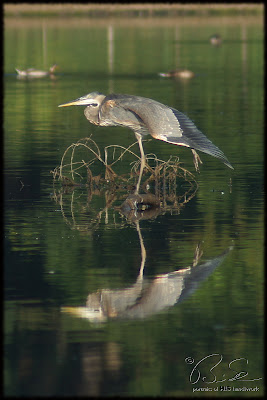
A Great Blue Heron seemed to be waking from what may have been its roost for the night.  I think they usually will roost in trees, but this may have been a safe spot for the night.  It was definitely going through a thorough stretch routine of each leg, wing, neck... That neck of theirs is quite something.  All herons have very long necks, and they seem to have a couple of hinge points allowing them collapse quite compactly.  I search on the net quite a bit and didn't find anything specific about it.  Notable is that herons do this, but cranes and geese fly with their necks fully extended.

Great Blue Heron waking up.
Great Blue Heron wing stretch.
Great Blue Heron neck stretch.

On the way back to the car, heading back to work, I had to try and capture these sights... the dew was heavy on the huge number of spider's webs all over the golden rod and other brush.

Morning dew on a spider web.
Spider

On the way home that night, I saw quite a few birds and stopped making me quite late for supper.  Some how, at the moment it seem perfectly logical that a stop is justified and that it will only take a couple minutes.  I don't often have the camera in the car on the ready, so this time I didn't resist.

I stopped first at a bridge on Hwy 5 which crosses Spencer Creek where I very regularly see a Great Blue Heron  in the shallow waters.  I thought I'd try and sneak up on him.  I didn't work and I only got some blurry fleeing flight shots.  What I hadn't noticed was a Green Heron right on the shore, just in front of me, close to the bridge.  I was just about to leave and I must have finally scared it and it flew up into a tree a little ways off.  I have had similar things happen often, and I have to remember to look around more carefully after having seen one bird - often there are others.

Green Heron.

On my detoured route home, I drove past, turned around and shot this Red-tailed Hawk from my window before it grew too wary of me and flew off.  Further on my drive I repeated for a much larger Red-tail which was likely a female, being larger than the males.

Red-tailed Hawk

Red-tailed Hawk

I've noticed this set of woodpecker holes on a dead tree I pass every day to and from work.  I've seen a woodpecker right at the hole once during the summer, but as mentioned earlier, I rarely have the camera with me and am often on my way to work or just about home.

Woodpecker nest?
This time I stopped and noticed a dead Elm close by where there were a number of Red-bellied Woodpeckers flitting about from branch to branch along with a number of other birds.  There are 6 birds in the picture below, and at least four different birds.  If someone is really good at silhouette, they can fill me in on what they think the other birds are.

Can you find the 6 birds in this photo?  One is a Red-bellied Woodpecker.

Below is some help... I've received a few comments already on this one. :)

1. ???
2. Blue Jay
3. Mourning Dove
4. ???
5. ???
6. Red-bellied Woodpecker

Just down the road is Fairchild's Creek and again I almost snuck up on a Great Blue Heron.  A Belted Kingfisher chided me as well and stayed long enough for a distant photo.

Belted Kingfisher

I seem to have days where I get to see lots of birds all one after the other, and then other days when I see next to nothing.  Well, I'm still behind on posts, so there are more to come for the blog anyway.  One more blog post on the Princess Point area of Coote's Paradise to come, and then a post on a trip up to the Lodge again.  Fall is coming with the crisp air, full bodied clouds and blue skies, amazing colour display of the turning leaves.  Fall...my favourite season.


Sunday, February 5, 2012

"New" Lens

I'm taking a few minutes for a break from cleaning bathrooms, getting at least one of the kids to keep the vacuum cleaner moving through out the house, and feeding the washing machine with never ending supply of laundry. :)

the "new" Tamron lens

I mentioned back in December that I had purchased a new lens... it's new to me, but actually it's likely about 13 years old.  I bought a Tamron AF 28-300 F3.5-6.3 LD Aspherical IF 185D off Kijiji after looking here and here for the only real reviews I could find.  For now (and may never be) it is not in the budget to purchase some of the fine glass that is out there to take really crisply focused shots.  I paid $100 for the lens and a Minolta 3600 HS D flash which I thought was a good deal.

The benefit of the new lens is that it has some low dispersion (LD) glass in it.  My previous Sony kit lens is all plastic elements.  So the new Tamron lens doesn't get the chromatic aberations (CA) or purple fringing nearly the same as the Sony lens.

Here is a shot of a kingfisher at Bayfront Park this January, which on the Sony lens would have turned out with all the branches being purple.  The bottom right side still has a slight bit of the CA happening, but not as bad as the Sony lens would have.

Belted Kingfisher

Another plus of the Tamron is it's bottom end of the focal range: 28mm  vs 70mm of the Sony; a welcome extension to the almost wide angle range.  It actually is 42mm (1.5 x 28mm for the APS-C sensor size) so not wide angle, but still provides a bigger range on the bottom end all in once lens.  It also "collapses" into a smaller length than the Sony which is nice for carrying around.

...Well, it's now the next day... :)

However, a trade off seems to be that the Tamron doesn't seem to be quite as crisply focused at the longer focal lengths out to 300mm.  That is somewhat frustrating and I feel like I have to choose between the CA issue and focus quality.  Especially with birding, it's often that you're shooting against sky and back lighting, so the CA often creeps up.  But it is never enjoyable to trade of good focusing!

Another thing I've noticed, is that the Tamron doesn't get you in as close as the Sony does.  Although they both say they are 300mm lenses, the Sony zooms in closer.  Does anyone know if lenses are given their focal lengths like car's engine sizes are - rounded up often somewhat dishonestly?

Oh the trials we have to we go through as relatively wealthy people!  Much of the rest of the world has to make decisions which involve how to feed or put a roof over their families.