Yesterday, my brother Dan (check
his blog for a post eventually? :) ), his son Josh, and I headed to St. Catharines in hopes of seeing at least one of the two Snowy Owls which have been there since before Christmas. I had known they were there for a while, but hadn't really had the time to make the trip all the way to St. Catharines - I haven't really done any bird "twitching" (quickly travelling to see a bird). Snowy owls do appear in our neck of the woods from time to time, but it certainly is not common. Last year there was one for a short while in southeast corner of Hamilton harbour and another appeared in Oakville along the Lake for a couple weeks.
I had had another commitment that morning, but we headed out with bright sunshine, and we drove to the location shared with me by Dave Van de Laar and my brother Rob where the male owl had been routinely sighted. As we searched for the bird, spotting the small cluster of cars and people along a small country side road was the immediate clue we were there. It didn't take too long to spot the beautiful bird, but had it been a completely snow covered field rather than the centimeter or snow which had freshly fallen overnight, it would have been more difficult.
 |
| Can you spot the Snowy Owl? |
The mature, male Snowy Owl is almost completely white with muted black markings. Females retain the dark barring that the young start out with. Photographing something pure white against a snowy background is a challenge and stretched my skills, having me doubting myself a couple times as a photographer next to me kept providing advice about bumping up the exposure - advice which I still think was either wrong or he had his terms mixed up? Still not sure.
 |
| male Snowy Owl |
My pictures are significantly cropped - the owl was a good 100m from the road and the field is marked with recently posted "private property" signs. Aside from giving the owl space, the field side of the ditch was the limit our advance.
 |
| Snowy Owl leg stretch |
Unfortunately for my nephew Josh, he had left his camera at home, resulting in understandable disappointment. He shared the camera with his Dad and got to use my binoculars most of the time. That ended up having its benefits and he ended up likely having the most profound experience of us all. He was looking through the binoculars and the owl suddenly took off, flying almost directly towards us. With the close view of binoculars, he suddenly jumped and exclaimed, "He's coming right at me!" I'm sure it pretty much his entire binocular view was filled before he jumped up to see the owl fly within about 15m of us and snatch a white mouse which we had watched meandering through the snow for the last 30 minutes. It was an escaped mouse from some other people who had been attempting to bait the owl. They had since left. It's amazing to think of the extremely sharp eye sight to spot that movement, especially since the mouse was white!
Here are a series of photos of the take-off and then landing afterwards with the catch. Obviously missing is the actual catch. But it was so close in front of us that it was hard to capture it. Photographing a moving, almost uniformly white subject against a background with lots of sharp focus points (stubble) is a challenge. The camera quickly decided on the stubble instead of the bird many times as I had switched it to the wide selection AF mode.
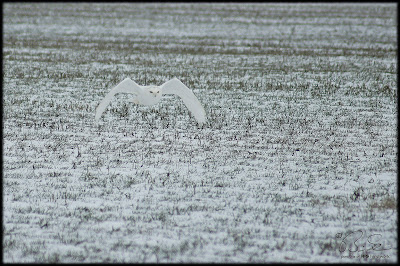 |
| Gathering speed. |
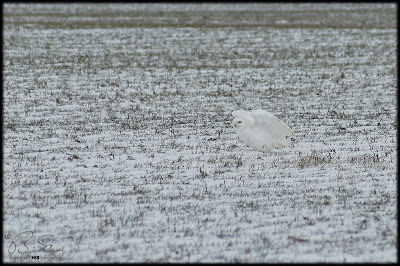 |
| Touch down. |
Snowy owls breed in the Tundra up north, only coming into our area rarely, usually because there usual food supply of lemmings and voles are decreased. Apparently when this owl arrived in St. Catherines, it was quite bedraggled but has since bulked up again. Very likely due to all the baiting it is receiving which is not seen to be a good thing as it may hesitate here too long and not head north again as it should. They usually dwell on the ground, often on a small rise, knoll, or snow drift, conserving energy and watching and listening for a small animal to catch, flying in flow and catching with the element of low, silent approach.
 |
| male Snowy Owl |
This last picture is a tease - for me! A lady set up beside me with a Sony camera and a nice big 150-500mm Sigma lens. I built up the courage and then asked if she minded if I could pop my camera on for a few shots. The picture below is cropped as well, but much crisper and missing the chromatic aberration my lens gives. I use a purple fridge reduction script in GIMP for my pictures, but the colours are still not as good as the uncorrected version off the Sigma lens.
 |
| Scanning the field for prey through almost closed eyes. |
All in all, a great few hours of watching a very beautiful bird. I'm glad we got to see it in flight once, and benefited from it moving a little closer to the road. But otherwise, it just sat relatively still aside from slowly scanning back and forth with partially open eyes, looking rather cozy and dozy in its thick plumage of feathers. Who knows when or if I'll ever get to see one again. Life bird #107 will stand out for a while. :)


