Showing posts with label shore birds. Show all posts

Monday, October 1, 2012

The Big "100"


As mentioned in my last post, I spent a few mornings at the mud flats of Coote's Paradise off the east side of Princess Point created by the lack of rainfall from the very dry summer and fall.  I waited for the golden glow of the early sun's rays to come over the tree tops.  With the slow advance of the edge of light, mud and water and shore birds became light enough for photographing.

Well, I hit the 100 mark on my birding life list!  Though not anywhere close to the huge count of Josh Vandermeulen who is currently doing an Ontario big year (At the time of this post, his blog reports he sits at 331, and we are all hoping he can surpass the record of 338.) I'm still pretty pleased with my 100th bird on my list.  At first I had not planned to do the list thing, but somehow it just happens as you start to tally what you have seen so far.  I'll introduce bird 98, 99, and 100 in order, all shore birds.

The first shore bird was from a group of Lesser Yellow Legs, wading in the soft mud hunting for small creatures living there.  These birds breed in Northern Canada and have pretty much finished their migrating pass through our area on their way south, mostly to South America.

Lesser Yellowlegs arriving.

Lesser Yellowlegs wing stretch.

Lesser Yellowlegs

Lesser Yellowlegs and turtle.

The next shore bird I found were a group of Least Sandpipers wading along the eastern shore just off the recreation trail which links with Bay Front Park.  They are the smallest of the Sandpipers (often called Peeps).

Trio of Least Sandpipers
My 100th life bird happened by accident really.  I was taking pictures of the Least Sandpipers and saw this bird up closer and snapped some shots thinking it was a more brave bird of that group.  But when editing, I noticed the markings seemed different.  To tell you the truth, I didn't even know what the Least Sandpipers were till after receiving some help from some other birding/blogging friends Caleb and Dwayne - thanks!  I have to admit that for the most part, many of the shorebirds all looking very similar and hard to clearly distinguish.  I'm sure if saw them more often and was routinely IDing them, that would change, but that is not likely to happen. For now anyways, the key to IDng the Least Sandpipers is their yellow legs.

Life Bird #100 - Semipalmated Sandpiper

A song sparrow was also foraging, resting the drier mud portions for bugs and other food.  Some Mallard ducks were preening across the water.

Song Sparrow
Female Mallard Ducks preening.

A Great Blue Heron seemed to be waking from what may have been its roost for the night.  I think they usually will roost in trees, but this may have been a safe spot for the night.  It was definitely going through a thorough stretch routine of each leg, wing, neck... That neck of theirs is quite something.  All herons have very long necks, and they seem to have a couple of hinge points allowing them collapse quite compactly.  I search on the net quite a bit and didn't find anything specific about it.  Notable is that herons do this, but cranes and geese fly with their necks fully extended.

Great Blue Heron waking up.
Great Blue Heron wing stretch.
Great Blue Heron neck stretch.

On the way back to the car, heading back to work, I had to try and capture these sights... the dew was heavy on the huge number of spider's webs all over the golden rod and other brush.

Morning dew on a spider web.
Spider

On the way home that night, I saw quite a few birds and stopped making me quite late for supper.  Some how, at the moment it seem perfectly logical that a stop is justified and that it will only take a couple minutes.  I don't often have the camera in the car on the ready, so this time I didn't resist.

I stopped first at a bridge on Hwy 5 which crosses Spencer Creek where I very regularly see a Great Blue Heron  in the shallow waters.  I thought I'd try and sneak up on him.  I didn't work and I only got some blurry fleeing flight shots.  What I hadn't noticed was a Green Heron right on the shore, just in front of me, close to the bridge.  I was just about to leave and I must have finally scared it and it flew up into a tree a little ways off.  I have had similar things happen often, and I have to remember to look around more carefully after having seen one bird - often there are others.

Green Heron.

On my detoured route home, I drove past, turned around and shot this Red-tailed Hawk from my window before it grew too wary of me and flew off.  Further on my drive I repeated for a much larger Red-tail which was likely a female, being larger than the males.

Red-tailed Hawk

Red-tailed Hawk

I've noticed this set of woodpecker holes on a dead tree I pass every day to and from work.  I've seen a woodpecker right at the hole once during the summer, but as mentioned earlier, I rarely have the camera with me and am often on my way to work or just about home.

Woodpecker nest?
This time I stopped and noticed a dead Elm close by where there were a number of Red-bellied Woodpeckers flitting about from branch to branch along with a number of other birds.  There are 6 birds in the picture below, and at least four different birds.  If someone is really good at silhouette, they can fill me in on what they think the other birds are.

Can you find the 6 birds in this photo?  One is a Red-bellied Woodpecker.

Below is some help... I've received a few comments already on this one. :)

1. ???
2. Blue Jay
3. Mourning Dove
4. ???
5. ???
6. Red-bellied Woodpecker

Just down the road is Fairchild's Creek and again I almost snuck up on a Great Blue Heron.  A Belted Kingfisher chided me as well and stayed long enough for a distant photo.

Belted Kingfisher

I seem to have days where I get to see lots of birds all one after the other, and then other days when I see next to nothing.  Well, I'm still behind on posts, so there are more to come for the blog anyway.  One more blog post on the Princess Point area of Coote's Paradise to come, and then a post on a trip up to the Lodge again.  Fall is coming with the crisp air, full bodied clouds and blue skies, amazing colour display of the turning leaves.  Fall...my favourite season.


Monday, December 19, 2011

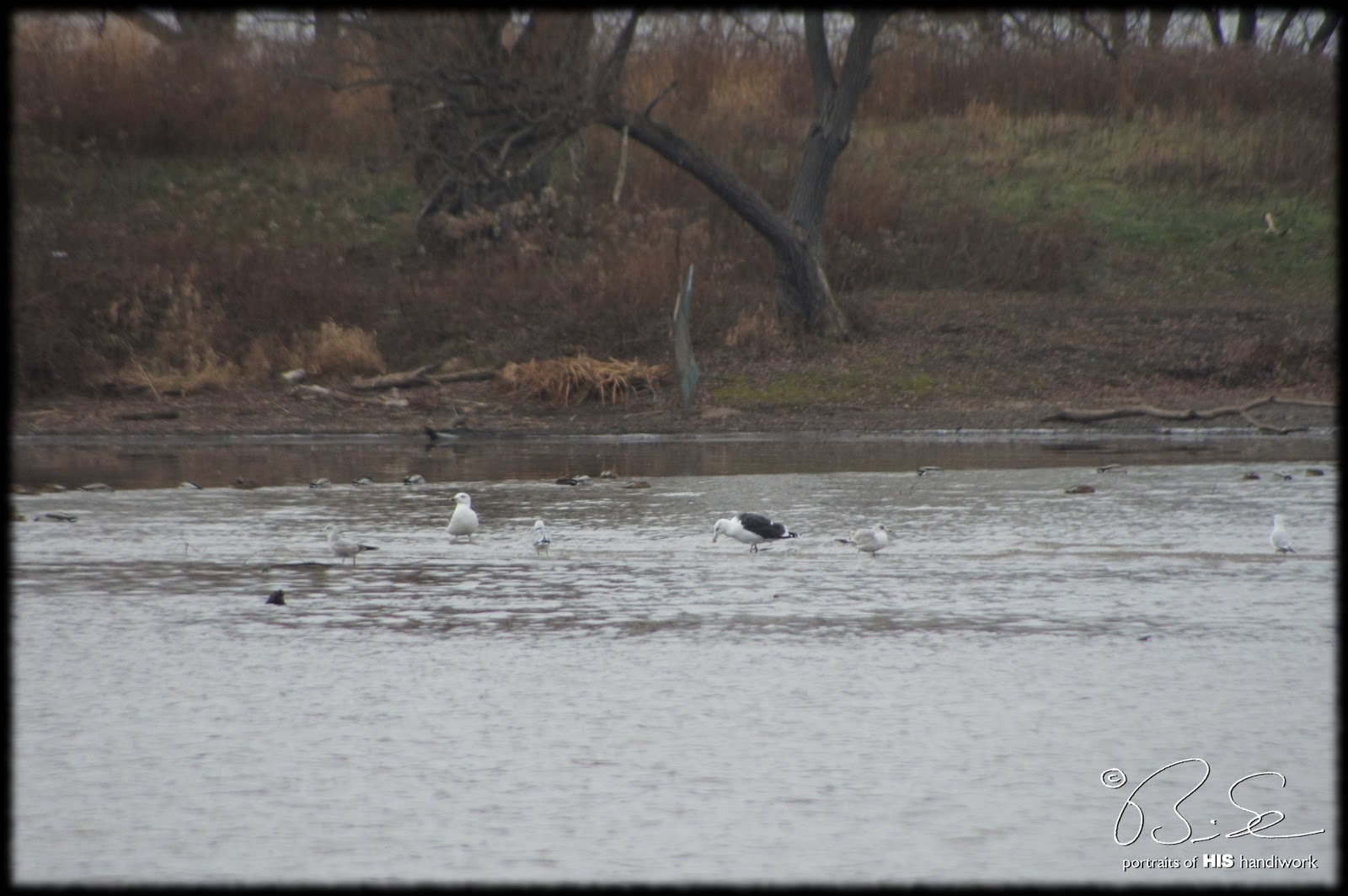
Not so Rare "Greater Black-backed Gull"

I purchased a new lens (new to me anyways) last week, and got to try it out at lunch today heading to Princess Point in Coote's Paradise and swing along the Bay Front Trail, heading a short ways towards Bay Front Park.  It was a gray day, but saw quite a few "firsts for me" birds.  What variety in Creation.

I also think my new found hobby got the better of me today... I posted on OntBirds (a birding list where you can post finds of uncommon or seasonally unusual birds) that I had sighted, what I thought was, an uncommon bird - turns out not. One person pointed out to me already that it's not really rare in this area, so, oops! ;)  I had thought I had seen on the blog of another popular birder in the area that it was.  I checked back and I had misread it.  Another kind birder on the list pointed out that I had likely identified the bird correctly as a greater black-backed gull, but that it wasn't male and female but likely one adult and the other in "one of the first to third year plumages".  (Thanks Bob!)

Here are the photos anyways.  Amongst other ducks in the background, these gulls stood out clearly as they are much bigger than what seems to be common Ring-billed gulls we're used to seeing here.

Greater Black-backed Gull  (adult and 1st to third year)

The older one seemed to be trying to break something apart, possibly eating something?  This was a fully zoomed in shot, and my tripod is getting a missing part made (thanks to my brother who's a machinist!), so it's not the clearest picture.

Greater Black-backed Gull eating something?

Some interesting facts I found from reading around on the net: Greater Black-backed Gulls are less like the

Wednesday, September 28, 2011

Older Photos

I was going through some of my old photos and doing some house keeping.  I found a few photos from previous trips to Bayfront Park that I hadn't posted and thought I'd share them.  I haven't done much of getting out to photograph anything of late.  Life is quite busy at the moment!

Mute Swan taking off.
I enjoy watching terns make their hunting circuits over the water.  There is something about how they fly that I like.  Their wing strokes are different from gulls, more definite and crisp with a kind of movement that somehow brings the word "lilt" to mind.  It seems so effortless, and you can see them sure ahead with every stroke.  They like to set up a number of  loops which they patrol a few times, and switching between them periodically.  When a small fish is seen close enough to the surface, they tuck and plummet into the water to pursue the prey.

Common Tern looking for lunch.

Wednesday, September 7, 2011

A Saturday Morning's "Work"

Continuing my narrative starting with sunrise pictures on VanWagner's Beach....

When Dave arrived, we headed over to VanWagner's Ponds, one of the locations I had thought might be a good birding location.  At least the OntBirds email list had said this was a good location.  We unpacked and set up our cameras to head down the path.  While we were getting set, a starling was chasing a cicada straight towards us, and last minute abandoned the pursuit as it came close.  Although it had been flying, the early morning temperatures must not have allowed the cicada to warm up enough yet, as it was somewhat sluggish still.

Cicada
Well, after scaring out two herons we didn't realize were there, we really saw nothing else. The ponds have higher banks which were mostly filled in with bull rushes, not the greatest for trying photograph through without hipwaders.  We soon decided to head on over to another location I had also seen on OntBirds - Windermere Basin.  However, it was nothing like what the Google satellite view shows, as it is under some very major construction.  Again, we saw a few herons and shore birds, but none within range, and certainly not with an attractive backdrop.  

So, off we went to RBG, hoping the Henrdrie Valley area where we've both been a few times would provide better success.  On the way though, we stopped on Eastport Drive where there is a small strip of land in Hamilton Harbour which is a nationally designated bird sanctuary, mostly for cormorants.  This narrow portion of land has been populated by hundreds, if not thousands of cormorants, their feces completely killing any vegetation along it.  

Cormorant Nesting Tree

Wednesday, June 1, 2011

Myrtle Beach - March 2011 Part 2


Continuing my Myrtle Beach post from a few weeks ago....

I went for a late afternoon trip to Huntington State Park - to see what there was to see.  There is a very nice, untouched and ungroomed beach here compared to the beaches by the condos.  There are some mild dunes that find themselves between the southeastern forests and the ocean.

Beach at Huntington State Park
Here are some of the shore birds I was able to see and capture some photos of.

Willett Sandpiper
The Willett Sanpiper is one of the larger in the sandpiper family.  It's about three times the size of the sandpipers were used to seeing on the beaches in Southern Ontario.

Willett Sandpiper
The Ruddy Turnstone gets its name for doing it exactly what it sounds like, flipping stones over looking for bugs and small sea creatures to make lunch out of.  Sometimes they will dig holes larger than themselves pursuing something like a crab, burrowed in the sand.

Ruddy Turnstone
Apparently, if you've seen a shore bird, you'll most likely have seen one of these - a Sanderling - as they are the most wide spread shore bird in the world.

Sanderling in Winter Plumage
Also at Huntington Beach State Park, there is a unique feature called a salt water marsh.  The tides flood it with salt water, and it is a breeding ground for things like shrimp.  The egrets, herons, and terns usually flock here, but I must have hit a slow day.  I saw some, but not many...

Immature Double Crested Cormorant sunning
Great Egret
Great Blue Heron
Snow Egret
Great Egret
The park also has a fresh water lagoon which had a large number of American Alligators.  They got quite close to a number of us were standing (about 5 other photographers there - with much bigger "fire power"!!) which was somewhat unnerving at first.  However, we were up an embankment which separated the fresh water lagoon from the salt water marsh.  Apparently they cross this every night, and we were counting on the fact that they were planning to do this later in the evening when we were gone.

A young American Alligator
A younger American Alligator, waiting in the algae.  Probably was about 5 ft long
A large bull American Alligator sunning in the mud.
American Alligator - swimming towards the crossing point we were taking pictures from.  It was probably about 12 ft long.

The common Moorhen is a unique bird.  The males exclusively build the nests, but they build more than one.  One is used for hatching the young, but when the babies are mobile, they will travel around use the other nests for sleeping at night.

Common Moorhen
And of course a turtle had to be sunning somewhere...
What I think is a River Cooter
As I was leaving, I saw this Merlin up in the trees. Though I followed it for quite a while, it was not going to let me get too close, so this was the best I got.  The Merlin is a small falcon, very active and very aggressive, often pestering and competing with larger hawks.

Merlin
All in all, a great 6 hours or so of enjoying a wide variety of animals and birds I don't get to see in my part of the world.  What a vast number of creatures He has made for us to enjoy and marvel at.