Showing posts with label nest. Show all posts

Saturday, June 1, 2013

Two Nests and Two Life Birds

A little bit back, I saw activity on the bird boards that there were some American White Pelicans in the area and that they had recently moved to Coote's Paradise and were spending time on a sandbar of one of the small islands there in the mornings.  I decided to head into work early to see if they could be sighted.  It didn't take a second glance to confirm they were their.  They are huge, and their size and pure white plumage stood out in stark contrast to the cormorants that were making their company.  I had no close access, so had to make due with a tripod shot from on on the ridge that York Road follows.  These shots are quite cropped, but definitely show the dark flight feather markings of the bird landing. An exciting life bird (#122).


American White Pelicans with Double-crested Cormorants in Coote's Paradise

American White Pelicans

That lunch hour I headed to Valley Inn Road, and headed down the Grindstone Trail.  The songs of many birds filled the air and the distinctive sweet sound of the Yellow Warbler belied its location for a brief picture.  Interesting how birds will still sing even while preening.  I guess that's a lesson in doing your work with cheer!


Yellow Warbler preening

As I headed further down the trail I was met with another flurry of yellow, but darker, larger, and mixed with black. Three Baltimore Orioles were loudly dueling over territory, and later, I discovered a nest right in that vicinity, so one male was courageously dealing with two trespassing intruders.


 Baltimore Oriole nest - way up in the top of a big Poplar Tree


male Baltimore Oriole
 
female Baltimore Oriole

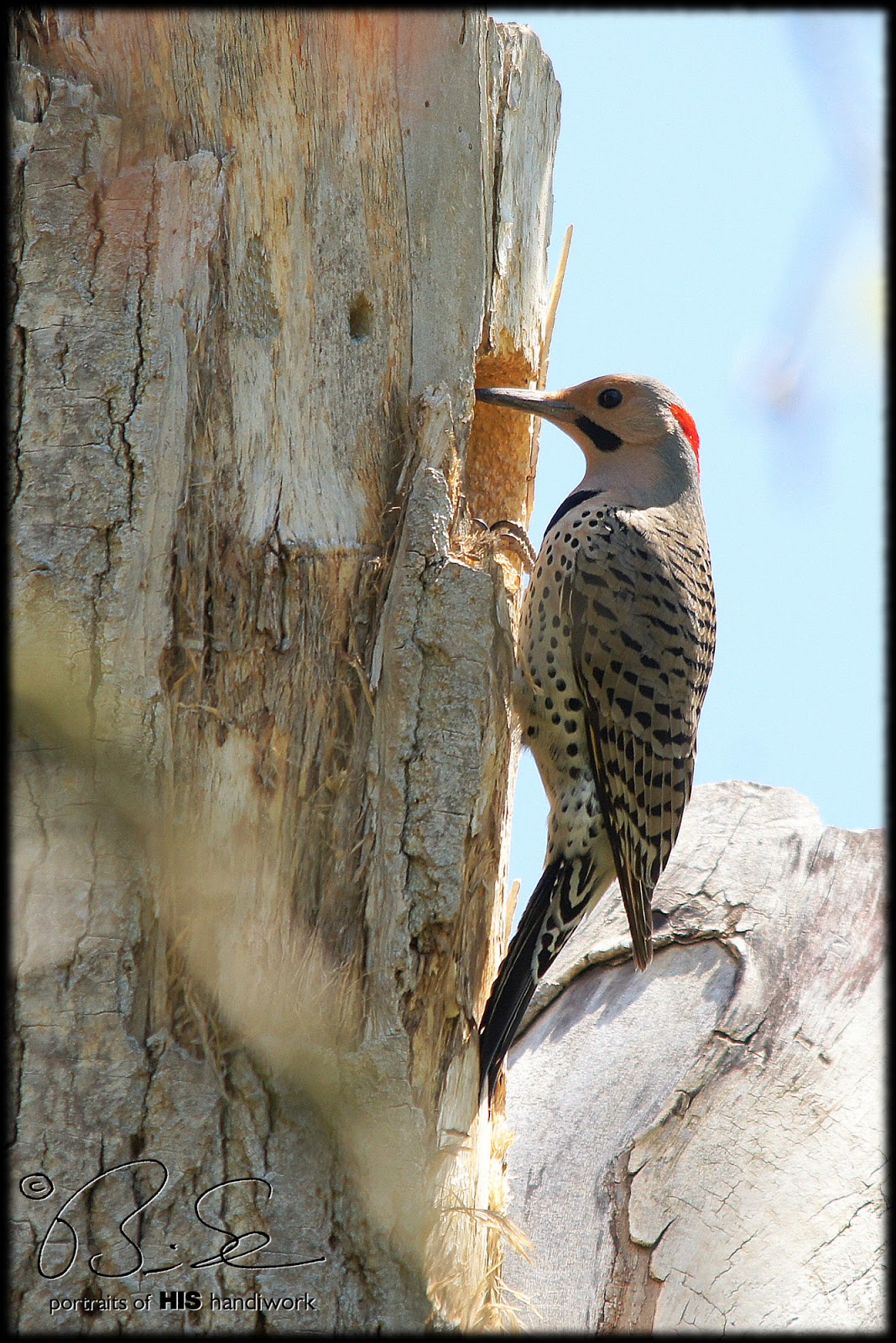
Further down the path, I startled two Northern Flickers off a dead snag, and with a second look, noticed that there was a freshly chiseled opening.  Biding my time, I settled in for a wait, and sure enough, one returned to what was confirmed as a nest.  Inside he popped, promptly checking on whatever was inside.

Northern Flicker nest entry

Northern Flicker
Northern Flicker
Northern Flicker

 After tolerating my presence for a while, suddenly the bird became quite agitated, squawking and looking down below.  I wasn't sure why, but soon it left and I saw the reasons... a Red-bellied Woodpecker pair were on the same tree, and a flurry of chasing began.  It was too fast to try and get any pictures and not one even caught anything.


Protesting the visitors

Notice the Red-belly on the bottom of the picture
and the Flicker at the top.


male Red-bellied Woodpecker
Strangely, it all seemed to end quite quickly, and the male Red-belly remained to feed on a tree just next to the snag with the nest.  It was quite unconcerned with me.

Red-bellied Woodpeckers were given the wrong name in my opinion, given the inconspicuously small patch of slightly red belly they do have.  Others have written the same and I agree with one writer who thought they should have been called "Ladder-back Woodecker".  You can see why in the picture above.


male Red-bellied Woodpecker feeding on ants from a branch hole.

male Red-bellied Woodpecker feeding

Hoping not to belabour the Flicker pictures, I got a couple pictures with the bird blinking. Woodpeckers have a number of significant design features which are all necessary for it to survive its interesting habit of whacking its head on trees (see a previous post about this here about this bird's design features).  One thing they need is strong eyelids to protect and keep their eyes from popping out of their sockets as their head stops with the impact.

Thick, protective eyelids.


I was met by a nice lady who had just spent an hour just around the corner trying to photograph Kingfishers which I had heard noisily rattling away from up the creek while I was at the Flicker nest.  When she came by, I kindly pointed out the Pileated nest.  She got very excited but couldn't seem to spot the nest hole I was pointing her to.  Seems, I had, as I wrote above, mis-spoken. Oops, not a Pileated, a Flicker nest.  Then I understood her excitement and the fact that she could not spot the very large hole that would be present had it been a Pileated Woodpecker nest!  I subtly tried to regain some of my reputation and hoped I could assure her that, although not an expert, I did know what I was talking about. Susan posts some very nice pictures here.  Sorry for disappointing you Susan!

And if I'm honest, I think I was also pointing out following Orchard Orioles (the pictures above), though it obviously turns out that Orchard Orioles are much more of a dark, almost chestnut colour.  Boy, did I ever eat humble pie that day!

In the same area as the Flickers, there was a pair of tiny Blue-gray Gnatchatchers busily harvesting tiny bugs from a flowering Pin Cherry tree.  They are such tiny, cute birds.


Blue-gray Gnatcatcher

Blue-gray Gnatcatcher - funny look

On my way back to the car, another pair of small birds caught my attention as they flitted about in the trees... They didn't stay long, but I got enough distant pictures for Peter and Caleb Scholtens to help me ID it later on as a Warbling Vireo.  (life bird #123) 2nd of the day!


Warbling Vireo

Just across from the parking lot, this adult Racoon was out in the middle of the afternoon, an odd time for this generally nocturnal animal.  Made for a nice picture though!


Racoon in broad daylight.

More life birds and good times still to post....
Keep enjoying His handiwork!!


Thursday, April 26, 2012

Nesting Sandhill Crane

Where did spring go?  Snow recently?  I guess we are actually experiencing spring now, and summer is back in it's regular place after spring!  Looks like warmer weather is coming though.

Sorry for the delay on the nesting Sandhill Crane shots I promised a while ago.  Though I doubt anyone was  changing any part of their life with the holdup on this post.  I've been under the weather lately with a cold/flu that just doesn't seem to want to leave!

This post is going to be sparser than usual on the words and I'll just let the pictures do the talking... I'm off to bed earlier these days trying to get rid of this bug which just seems to suck the energy out of me!  I hear there are a lot of people struggling with similar, nasty bugs too.

This was the first sight I saw as I returned to try and find the nest Dan found after I had left last time.  I was in the wrong spot, but enjoyed a bit of a closer view as this crane perused the grass for small crustations and insects to eat.  It slowly wandered to the south into the leafless bushes out of sight.

Sandhill Crane
Turns out it was headed over to the nest site, where it later "hovered" in the background keeping an eye on us.  It didn't seem distressed or concerned, but quietly kept us under surveillance.

Sandhill Crane patrol.
Dan arrived a bit later and pointed me to the correct location of the nest.

Grass Lake and the hills beyond.
The golden, afternoon sun nicely lit the bid bird on the nest.  Budding leaves from the trees behind us on the bank will soon block out this desirable lighting.

Sandhill Crane nesting.
Just as we were going to leave, it stood up, giving view to two large eggs which will hatch after about 30 days of incubation.

Sandhill Crane turning the eggs.

Thanks again to my brother Dan for finding the nest!


Saturday, April 14, 2012

Sandhill Crane Success

Not always, but sometimes patience pays off.  Or persistence at least. Lately, I've taken a few Sunday afternoons to go to Grass Lake hoping to see the Sandhill Cranes that have been seen, back for their summer stay to raise another brood. My first two Sundays' attempts were filled with good company: my oldest son the first time, and then another birder/photographer I spent over an hour chatting and swapping stories with.

However, this time I arranged to meet with my brother Dan who had just purchased a new camera and was eager for an excuse to come out. I was hoping it would not be another failed attempt to find them. Thankfully, that was not to be, and before he joined me I had already spotted a lone crane preening out in last year's grasses of the wide marshy area of the lake.

Sandhill Crane preening.
We took turns balancing on a log that protruded part way into the lake to enable the closest view possible. The misting rain held off long enough for us to enjoy the sites of this large bird that is part of a small number of cranes that seem to return to this location for a number of years now. Although the birds number in huge quantities and flocks are often in the 10,000's, they're not very common in this area. 

Post preening nap.

After having poor success in seeing them previous times, the tide had turned and soon we saw another four flying about in the back stretches of the lake. Soon two flew over and noisily landed in the distance behind where the preening crane we were watching was stationed. They are big birds.

Sandhill cranes coasting in for a landing

We traipsed over to the side of the lake where the two new visitors had landed, but couldn't see much more than glimpses as that side of the lake's edge is quite grown in with vegetation at water's edge. However, we caught site of a Canada Goose nesting, and trying hard to keep from our notice although in plain view. It wouldn't move an inch the whole time we watched. Not sure if this is more characteristic of more "wild" geese compared to the more "domesticated" park variety. I'm more used to encountering the geese who make you feel you need apologize while you walk around them on a trail they happen to be sauntering down as well.

Canada Goose nest.
I'm not sure if this nest is the handiwork of the subject goose, or whether it is leasing the roof off of a muskrat. I'm thinking this is quite the mound for a goose to create, but possibly this is the fruits of many years of nesting at the same location.

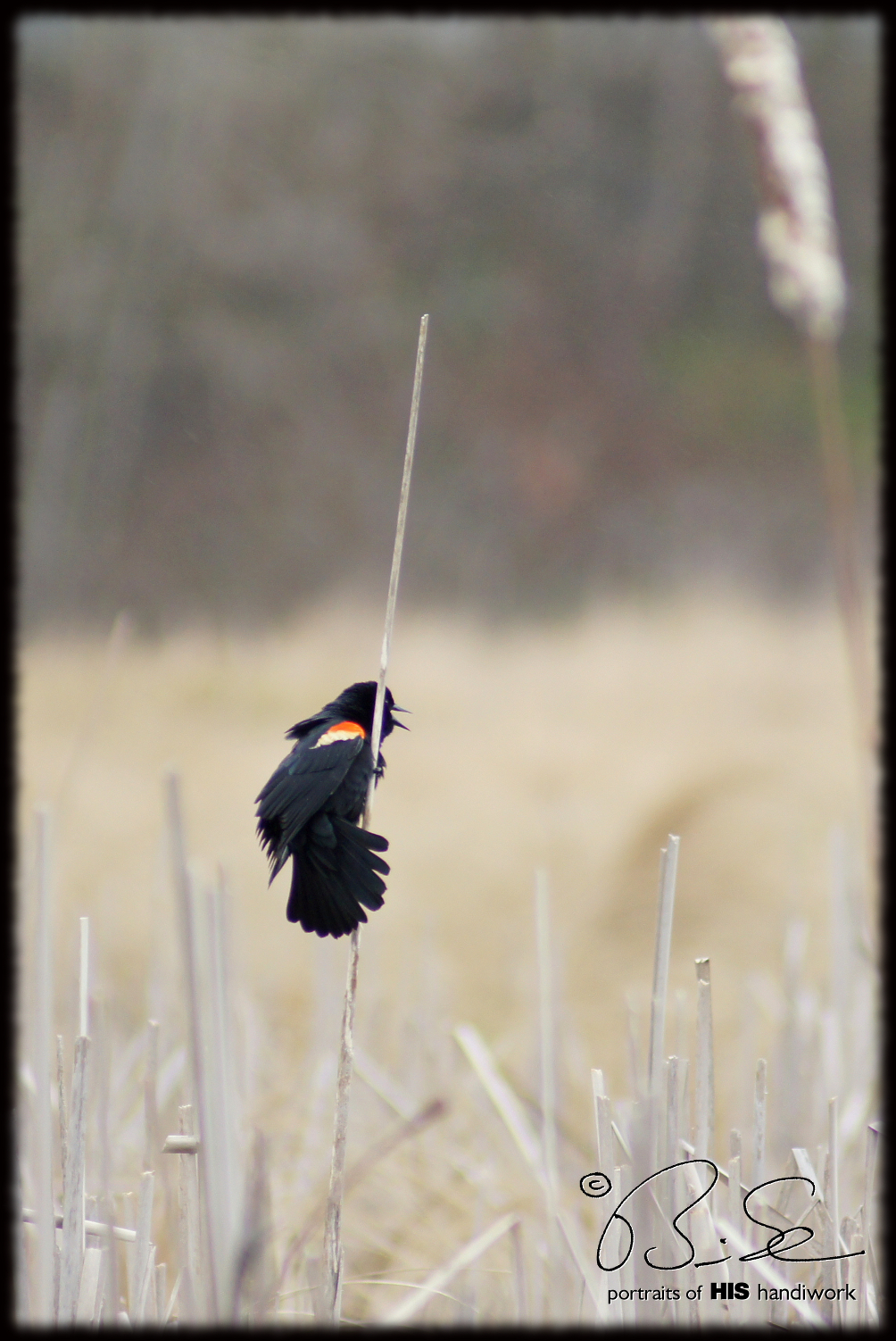
Red-winged Blackbirds abounded, their raspy calls filling the air with the corresponding feather-spread displays. The drab weather and lighting didn't help for exposing a black bird, and they always seem to know where the camera is, insisting on facing away.

Red-winged Blackbird

With time running out for on a successful outing, a Turkey Vulture lazily circled and dropped down quite low... never turn your camera off until you're in the car. This was a bit of a hastily taken shot somewhat salvaged with Picasa (which I have taken a liking to lately with relatively easy touch-up [I try to keep my editing to a minimum], except for a purple fringe correction in Gimp to compensate for my inferior Sony lens!). This is the closest shot I have gotten yet of this large bird.

Turkey Vulture

I had to leave before Dan did, and he excitedly emailed me later that day letting me know he had found the Sandhill Crane nest we had gone out to find (on report and picture evidence from others on a birding board I frequent). Although we had just been, excitement won out and our wives agreed to the likelihood of two dads being late for supper, arrangements being made to meet the next day after work. I'll save the pictures from that outing for another post which I should get out soon.

Friday, April 6, 2012

Great Horned Owl and Young

We headed to my sister-in-law and brother-in-law's place for the afternoon today, and enjoyed the warm sun on the deck while the kids played with their cousins leaving us to a great visit.  Being situated in a beautiful spot half way up the Niagara Escarpment, I got distracted often by the many Turkey Vultures lazily circling the bright blue sky, often close overhead.  When I finally got the camera out, they decided to keep their distance.  Earlier a pair of Red-tailed hawks had landed close by in the crown of a spruce close by, calling to each other with their famous forlorn but piercing cry.  Of note, this cry is what you almost always hear in the movies, even if the bird is an eagle or other raptor.  

Great Horned Owl nest - as close as we could get from the top of  a ridge.

At one point Jer mentioned he had heard of an owl nest down the road and thought he knew the general location.  With no need to ask me twice, we headed off to see if it could be found.  With little effort, the nest was spotted about 50m from the road.  The large stick built nest was in the crotch of a large tree centred in the middle of a ravine the road followed.  Almost right away we saw movement in the nest.  Then, the sighting of characteristic, widely spaced tufts and the size of the bird produced the excitement of knowing it was a Great Horned Owl!

Great Horned Owl nest with young

I've only been sure of seeing an owl twice before in my life, both only being a silhouette as I drove in early morning.  One was perched on a road sign and the other on a hydro line.   The latter I had enough of a view to be quite certain it was a Great Horned Owl, indicators again being the "ear" tufts and size.  The only other time I believe an owl crossed my path was in very late dusk, also driving, when I saw a large bird glided a great distance across the road from one field to another, and the shape just seemed different than what my brain is used to registering as a hawk.

But back to today, even more reason for excitement was viewing confirmation on the zoomed in camera preview that there was at least one young one in the nest.  The white fluffy down, and another set of big yellow eyes was in the photo.  With the sun behind the nest, it was hard to see clearly though.

Great Horned Owl Nest 

To get a little closer view from the opposite bank and avoid the back-lit condition from the road, we crossed the small creek that calls the ravine home and crested the ridge in a farmer's field where we had a nicely lit view of two young owls with a huge parent keeping a watchful eye on us.  At one point while I had my camera glued to my eye, Jer saw a large shadow quietly but swiftly move through the forest and stop as something landed in a large tree off to the side.  We couldn't locate it, but I wonder if it was the mate which may have been drawn in by Jeremy's pretty good whistling imitation of a Red-tailed Hawk.

Cropped image showing the two young owls.

Great Horned Owl Fledglings

This was a pretty exciting find for me.  I've long hoped to see an owl in enough light to clearly see it and get some pictures, but never dreamt I'd get to see young ones as well.  If I lived closer to the location, I'd love to camp out on the ravine's edge and watch the activities of this owl family.  We couldn't stay long as the rowdy young in the relative's "nest" up the road would soon revolt should a meal not be provided there. With Jer on the soon fired up BBQ, a great meal was enjoyed with great visiting.  Thanks for making my day with the owl outing Jer... Oh, and thanks for having us over for the visit Maria - we enjoyed that too!


Sunday, March 11, 2012

Brantford Bald Eagles

On a dreary, windy, and rather cool day last Sunday, I took my two oldest boys Andrew and Jordan to see if we could find the Bald Eagles which had been reported to be actively tending a nest on the Grand River in Brantford near Brant Park.  We headed down to two known nest sites with very good information from Bill Lamond from the BrantBirds group.  We found the first nest without too much trouble, but didn't see any evidence of it being occupied.

Bald Eagle nest - the original one
From this nest which is a little southwest of Wilkes Dam, we traveled downriver towards the second nest site to see if there was any activity.  As we walked along the bank, we passed an old Indian dam, the remnants of which are only evident at this time of year by a relatively straight line of agitated water as it tumbles over the rocks placed there years ago to raise the water level.  I've tried to find out online why the Indians built a dam here, but couldn't find anything about it.

We met a gentleman on the path who lives just south of the area, and he pointed us to an eagles a bit down river of us where he had just waked from.  He also pointed out to us the site of the second, newer nest which I understand was built over the winter this year.  He said the newer nest is built in a huge old Sycamore tree, lower down, and much more stable.  It's larger than the old one too, though not very visible from where we were standing.  No one seems to be sure why, but the eagle pair has decided go back to the old nest which they attempted unsuccessfully last year to raise young in.  The old nest is higher up in a more slender tree, and it was swaying significantly in the blustery weather we buffeted by.

Bald Eagle
Not long after we had arrived, the eagle had had enough of this lookout point, stretched out its magnificent wings, lifted off, and turned back to soar up river towards the active nest.

Bald Eagle in flight.


From what I am reading and learning online, I would have to guess this is the female.  When side by side, the female is larger in overall size, and in wingspan.  But apart, and if close enough to tell, the clearest ways to tell are:
  1. Eye shadow and eye brows: The female has a very pronounced eye brow and around the eye it looks like she is wearing eye shadow.
  2. Mandible end point: the female's mandible ends at or almost behind the eye where male's is closer to before the eye.
  3. White head: the male's is almost always brilliant white where the female has some faint streaking in it.
Here is actually a pretty good link for a short video where they go through the visible differences.

We followed the flight back to the nest site, and got to see the two eagles on the nest together.  If I'm correct that we had seen the female earlier, she relieved the male of egg sitting duties.  A post on BrantBirds says that at least one egg was laid on Feb 29th which would mean that about April 4th (35 days) the egg would hatch.  Its unknown how many there are, but it would seem there are eggs with obvious duty switches and persistent nest watch being taken seriously.


Male Bald Eagle leaves female (just visible) a turn on the nest.

I returned for a second visit today again and saw both the eagles.  I didn't get many pictures but will post a short description with photographic evidence soon.  Even though I didn't get many good pictures, it was a beautiful day standing in short sleeves, enjoying the warm sun!

After just getting lost part replaced by my machinist brother, I left my tripod there - I had lost track of time and had to rush to get home and back to church!  But I'm grateful to Sue, who I met and spent the afternoon watching the eagles with, for taking it home with her till we can cross paths in the near future so I can get it back!  Thanks Sue!


Tuesday, July 12, 2011

American Robin Nest


Another nest in the backyard.  This one, a Robin's nest, got very close to coming to its end as it was in our wagelia bush which I was trimming drastically this past Saturday.  Just as close was the female robin that flew out just as the hedge trimmer passed by the nest which ended up being only about 6" in from where I cropped the bush to.  It had stayed there, bravely, till the last minute.

Four "robin's blue" eggs.
Somehow what I didn't notice till editing the pictures this evening, was that one of the eggs already had a small peck hole in it (bottom right egg).  I have still to see a baby bird hatch from beginning to end.  Well, Sunday was a full day and I never ended up going back up to look.  This evening, there were already two little ones hatched, and... one was just crackin' out of its already split egg.  

Last push.

Mom?

Hard hat?

Already looking for food.

Beat!

Robins are a big part of the summer scene here, always hunting across our grassy lawns, tilting their heads and then straining against the worm's desperate grips on the last inch of dirt.  Robins breed their two or three broods of young each summer up in Canada and northern US before heading south again.  We see them often, and usually are falling asleep to the males singing away in the warm, summer evenings, and then having them waking us up at 4am just outside the window left open to let in the cool evening air.  Living in Southern Ontario, you're quite likely to have seen a nest as they will top your outside porch light, arbour, or many other places within easy view.

You can see the eye slits staring to develop to allow this chick to see in about 4 days.

But here are a few facts you may not have know about this common bird:
- Robins aren't listening for the worms while they're out on your lawn.  They're tilting their heads only to carefully see straight on with one eye for the wriggle in the ground as the worm comes up to the surface.  Robin's eyes don't pivot like ours.  They will "pounce" to get into the ground a bit around the worm that might only be slightly protruding to get a good grip.  They may also "stamp" the grass to try and make worms in near vicinity give themselves away and move when they feel the vibration.
- Worms only make up about a fifth of Robins' diet.  They eat lots of other insects and berries as well.
- You can tell if a male Robin is breeding if it has extra-black feathers on its head, darker than the rest of its feathers.

We'll see if the other egg will wait to hatch tomorrow morning and see if I catch it.  Not likely!


Friday, July 8, 2011

Long Point Provincial Park 2

Here is the second part of the Long Point post...

I spent one afternoon walking the campground and a bit of the beach in search of birds who were going to stay close enough to be photographed.  I wasn't terribly successful on that trek.  I did get to see a bird I had never seen before - an Alder Flycatcher landed for a brief moment a little ways away, though still quite far away for a 300mm lens (I cropped the picture significantly.)  It's not the greatest shot, but thought I'd put it in anyways.  I should mention that it's possible that it could be a Willow Flycatcher - according to one of the websites I use to figure out what I've seen, you can only really tell the difference by their songs - which I didn't hear and wouldn't have had a clue which one I was hearing.  Because at Long Point it's full of Poplars and Alder trees, I'm going to assume it was an Alder Flycatcher.

Alder Flycatcher a way out there.
I also saw Cedar Waxwing, Baltimore Oriole, Yellow Warbler on this jaunt, but not close enough to get any great shots.  The ironic thing is, the rest of the pictures I got (except for some Oriole shots at the end of this post), were all right by the comfort station.  One of the Park Rangers noted, as I was standing their taking pictures, that every year they have multiple nests around both the main comfort stations at the park.  Interesting considering all the people and pet traffic around.

The most fun, but hardest to get a good shot of, was a tiny Yellow Warbler nest with four little ones.   No matter which side I tried to take the picture from, angling to get a view where the delivery of the meal would be in view, the bird would choose the other side of the little spruce the nest was at the centre of.  I did manage to get a few shots, but nothing straight on.

Yellow Warbler with plenty of bugs trying to stay just out of sight.

Somehow they know food is coming and jostle for position.

Two of the four young ones. They're about 50cm small at this point.

I did get this shot of a baby getting fed by a Yellow Warbler.  Only thing is, I'm not completely convinced this is a Yellow Warbler fledgling.  It seems bigger than the adult, and later on, I'm wondering if I saw a Baltimore Oriole trying to feed the same chick.  Anyone care to enlighten me who knows?

Yellow Warbler feeding .... ???

At the same location near the comfort station was this male Baltimore Oriole.  Although it was a day later, as I just noted, I believe it was feeding the same chick that I saw in the picture above.  I know that Cuckoos and Brown-headed Cowbirds are known to lay eggs in other bird's nests, leaving the nest owner to raise their young.  I don't think Baltimore Orioles do this though - I couldn't find anything on the internet which made me think so.

Baltimore Oriole with caterpillars.
One of our friends noticed a Baltimore Oriole nest high above in the trees near their site.  I have never seen one before.  Baltimore Orioles weave a hanging nest, the bottom a nice round ball, hollow in side with an opening on one side on top.  It's usually near the end of long branches for added protection.  Baltimore Orioles song sounds somewhat like a cardinal's, both in tone, and sometimes, somewhat in it's melody.

Baltimore Oriole nest.
The nest was quite high up in the tree. Having been treated to getting close at the Yellow Warbler nest, I tried to get closer by standing up on a picnic table - likely looking foolish to the rest of the group.  Oh well.  At least I stopped at only one table, and didn't stack another.  Amazing though how such a little bird has been given the ability to create such a masterpiece with pretty much a completely round nest.  I wonder how they get it started.

Male Baltimore Oriole feeding young - you can
just see the beak of one on the bottom of the nest.

Female Baltimore Oriole

I made one trek into the long grass lands towards the inner bays where there are acres of marshy areas, to see what there was to see.  Pretty dumb of me though.  Long Point is known for its ticks.  Lyme disease is known to be spread by female Deer Ticks which are found there.  Although it's apparently not quite the certainty that some make it out to be that you'll get it easily, get sick, and die; it's quite easily treated if you catch it early....  I went out and thought, as long as I keep moving, surely they won't have much time to climb up my shoes and legs, etc.  Well, as you can see from the two pictures below (no birds, only flowers), I obviously did stop, and though not for that long, it was long enough.  At one point I looked down and found, without exaggerating, at least 10 ticks climbing up my legs.  They all came off rather easily, and I was confident they were all Wood Ticks (or dog ticks) as earlier that day we had found one similar on one of my sons, and the Rangers assured us it was not a Deer Tick but the former.  Deer Ticks are half the size, and easy to distinguish with a reddish body and black near and including it's head.  However, you should still be careful, and even though I was walking on a mown path, obviously they still were getting on quite easily.  Lesson learned.

At the price of 10 Ticks... some shots of flowers which I cannot name.  My dear mother is the wild flower expert in our family. Maybe she will be able to identify these.  The first one looks like almost an orchid they way the flowers are arranged on the stem, and the long leaves in the background of the picture.

Wild Sweet Pea.
(Thanks to Karen for the info on the flowers!)
I'm guessing this is some sort of wild iris?

Wild Iris

Even though we were by the beach, I saw absolutely no shore birds other than the very common Ring-billed Gull.  The beach there has shrunk considerably with what must be higher water levels and possibly some erosion from some storms?  Didn't leave enough room for some good beach volleyball.  

A great weekend - till next year?