Showing posts with label common loon. Show all posts

Monday, July 7, 2014

LaSalle Park and Tresspassing

About a moth ago now, I went for a lunch hour to LaSalle Park. Late fall, winter, and spring this place is great for water birds, but I often don't go here because it's a little further away for my short lunch hour (ok, I'll wait for all the comments from people who only get half an hour!). But I thought I'd give it a go again for an early summery visit.

Walking down the trail east from the Pavilion parking lot, two Osprey were busy scanning the Hamilton Harbour Bay's edge and circling close overhead.  I wasn't aware of any nesting in this area, so I wonder if these two are the pair at the base of Hwy 6 and 403.

Osprey eyes me closely as it flies over.

Osprey

A little further down the trail, a Warbling Vireo paused long enough for a picture.

Warbling Vireo

This little male Yellow Warbler was not willing to pose and this was the best picture I could get.

male Yellow Warbler

A Baltimore Oriole was willing to show off its contrasting orange and black outfit.

Baltimore Oriole

A Gray Catbird pair were mewing at me, and I barely got this shot off as it perched out in the open for a few seconds.  Being much more shy than the similarly sized and shaped Robin, they generally prefer to be lower down among lower perches or even on the ground.  This bird wasn't happy as I approached and actually "bristled" its feathers and a show of strength.  I wondered if there was a nest nearby, but there wasn't any typical setting for that - usually a clump of shrubbery or something dense enough for their usual hiding place.

Gray Catbird

That was pretty much all I saw that day on that short visit.


I was out wandering in my neighbour's yard early one morning, quite annoyed!  I had heard a bird singing heartily since the early morning hours.  On and on it went and I didn't recognize it... not that I profess to be very good a recognizing that many bird calls yet.  At one point, I decided to just get up and find it; I wasn't going to sleep anyway.  It was actually across a church parking lot, across the street and behind the house of a neighbour we know quite well. In the morning, the sound travels well, but this little bird had quite the voice.
I'm embarrassed to say, it turned out to be a Baltimore Oriole. I don't hear them often, but somehow it didn't click.  I'm also embarrassed to say, I got caught in the backyard of said neighbour, who had been up early as well. I should have known better as I knew was an early riser and risking walking down her driveway was sure to get her quite confused as she couldn't see who I was.  I sheepishly explained that I didn't figure she'd be up and so I had risked it. She's way to good natured to really be upset, but had started to call me with a stern good morning until she figured out it was me. :) Ironically, I was out birding while she was up having already done a load of laundry! You're inspiring Jo!

As I apologized for startling her, I caught the unmistakable sound of the whistling of feathers that only comes from a fast flying bird... two Common Loons were also up early getting a head start on the morning commute and making use of the cool morning to travel some where. We don't have any resident loons in our area that I know of and being this far south, so they must have been late migrants.  Strangely, they weren't terribly high, which is where they usually are situated when they're making their long distance flights.  Loons are very fast flyers!  I remember doing a science project on them as a young kid in school... If my memory is still correct, their cruising speed is often around 100km/hr!

Common Loon flying over St. George

Common Loon

A short while later, I was doing my own commute to work at roughly the same speed.  Only thing is, a whole lot of technology was required to get me moving that fast.  And a lot more inefficiently!  What a marvel these creatures are. Yet, we never hesitate to look at the technology that we use daily in our lives and make the reasonable conclusion that it is obviously the result of a detailed and well thought out design.  And the more we learn and the closer we are able to look at the detail of the world around us... I still can only can conclude...


The heavens declare the glory of God; And the firmament shows His handiwork. Psalm 19:1-3

Till next time...
Keep enjoying HIS handiwork!

Monday, October 28, 2013

The Annual Summer Lodge Post

Well, I'm doing this post about two and a half months after actually taking most of the pictures on our annual summer vacation up north with my wife's family.  I'm getting further behind and taking less pictures than ever these days! Oh well...

One of the first things I do when we get there, well birding wise anyway, is to listen and look for the Merlins which nest and raise young every year on the opposite edge of lake where my in-law's cottage is.  Last year I noticed, with significant chagrin that the new owners of the cottage with the big old white pine tree which hosted the Merlin nest had been cut down.  I wondered if this year they'd still be around.  I was happy to notice them quite soon, and even more pleased that they seem to be spending more time on "our" side of the lake.  In the morning one day, one of the young ones spent a few moments in a snag not far from our beach.  It tolerated me for long enough to get a couple picture from a bad angle below, and headed out with its trademark "kalee kalee" call.

juvenile Merlin against blue sky.

My dear wife is agreeable to me heading out for a good chunk of a day that week, and I made a circuit of a few spots I've started to have success with over the years.  Tait Lake almost always gives good views of a Loon pair that nests there yearly.  I wasn't disappointed this trip either. 

Common Loon on Tait Lake

Common Loon

Common Loon

I only got one short bit of time though with some close up shots and the loon decided I was not good company and dove to a more distant section of the lake. While wandering around after, the calm morning water doubled the presence of some Mallard females.  They were different sizes, so I wonder if some were juveniles that hatched early in the spring and gotten all their adult plumage already.

female Mallard ducks

As I stood along the bank, I noticed something foraging right along the water's edge, hidden by the foilage growing in a short little undercut the water had made in the sandy bank.  At first I didn't really pay it much attention, but as it continued slowly along, I got curious, for some reason expecting it to be a Starling or something of that sort.  But as I approached, I saw it wasn't a bird at all.  Two black little beady eyes met mine on a dark furry face that froze as I did.  We both looked at each other wondering what would be next.  I knew if I moved it would be gone, but longed to get my camera up.  The weasel moved first and dove into the water for a getaway.  I had to clear some scrub and by the time I got my camera on it, it had made a surprising amount of headway meaning more distant picture. 

Weasel swimming across the lake.

A new mammal on the animal list though!  Because I didn't get more than a partially hidden view on land, and only the view of a wet back in the water, I can't say which of the two larger, darker species it was.  We have three weasels here in Southern Ontario, but I believe it was either a Long-tailed or Short-tailed Weasel. It was too dark and large to be a Least Weasel.

I headed on to Eagle's Nest to walk the Christie Trail loop. (I recently found a better link to a map for the park)  I didn't see a lot this time, but still got a few pictures. My first sighting along the trail to the Hawk Lookout was a Flicker.  Usually, you hear their scolding call first before you have a chance to see them.  However, this one seemed to eye me carefully first, let me take a partially impaired photo, and then beat a noisy retreat.

Yellow-shafted Northern Flicker

A teasing Hermit Thrush stayed just a head of me as headed to the Christie Trail and gave me only a few chances for an partial view for a picture.

Hermit Thrush

As I finished the walk along the trail which winds through the lower elevations and more open forest, a White-breasted Nuthatch was foraging along the tree bark and caught a caterpillar for a meal.

White-breasted Nuthatch

White-breasted Nuthatch

On my way back to the lodge, I stopped one more time at Tait Lake and this time both the loons were back in the small bay by the road.  I stopped and flushed one of the loons into the air as I got out.  That is strange as their preferred method is to dive as they do not get airborne easily. It made a long, running takeoff necessary to get this water loving bird out of the water.  They are actually very fast flyers, reaching speeds faster than most birds, but they need a very long takeoff to get into the air, "running" on the water's top for quite a ways to aid in gaining speed.  The first loon circled back over me again and I managed to get one half decent shot as it zipped by.

Common Loon fly by.

Not long after its mate took off, the other decided to follow suit, too quick for me to change my camera settings leaving me with only a few salvageable shots.

Common Loon takeoff

Common Loon takeoff

Common Loon take off

Although quite blurry, I kind of like this shot from right at the beginning of the takeoff.

Common Loon takeoff

Back at the Lodge there were other sights to see too.  Almost every summer, we experience one night when there is a emerging of flying ants.  They dig out of their underground habitations and take wing.  There to capitalize on the event are hundreds of dragon flies.  It's quite a sight.  Some years are more intense than others, and this year the numbers were not quite as big as other years.

Flying ants emerging and taking to the skies.

A nephew and I rigged a net and caught of few of the dragonflies to look at up close.


Dragonfly
Dragonfly
Dragonfly

Other insects inhabit the lodge grounds as well... I couldn't determine what type of grasshopper this was.

Grasshopper species.

A new butterfly landed just long enough to let me take a blurry picture while it took a quick "sip" from the sand.  I also could not tell what type it was for sure.  It think it is a Duskywing Butterfly.  Dwayne, do you know which one it is?

Juvenal's Duskywing Butterly (thanks Dwayne!)

Later that week, visiting our former Pastor and his wife who were vacationing on the opposite side of the lake the same week, I spotted one of the Merlin again. 

Merlin

Merlin

Don't hold your breath till the next post... my track record would prove to put you on the floor passed out.  But we'll see if I can't close the gap a bit.

Till then...
Keep enjoying HIS handiwork!


Sunday, May 5, 2013

Bayfront Park Finds

Another dated post here... The weather has finally been spring like here in Southern Ontario!  And it's great!  A couple weeks ago, I headed to Bayfront Park for a lunch break that needed to be shorter. The park is a quick 2 minute drive, almost literally down the hill from where our office is. I hadn't been there for quite some time and thought I'd see what there was to see.

In the Marina side of the park, a pretty pair of Lesser Scaups were dabbling around.  Click on the picture to see it full-size: I never knew Scaup's heads were iridescent.  This shot shows it brightly glowing purple.


Lesser Scaup pair

Next, heading off the paved trails, in a small, un-manicured portion of the park along the water's edge there was a small flock of Tree Swallows having spousal discussions about whether the price matched the location and the view of lots of brand spanking new bird nesting boxes around the park. 


Tree Swallow Pair

Keeing with the iridescent theme, these pretty little birds bright colours are brilliantly blue.  I didn't realize though that the females also have some nice little specks of the blue iridescence in their plumage too.


female Tree Swallow

male Tree Swallow

 As I rounded the point towards the "beach bay" I thought spotted a familiar shape, but check myself. This is necessary because in the Hamilton area, "that" silhouette is usually a Double-Crested Cormorant .  But, a second look confirmed my initial impression.  A Common Loon was diving for food.  Initially it was relatively close.  I wonder if it is a first year bird... though distant, the cropped pictures still seem to show just the slightest of the remaining brown plumage characteristic of a juvenile.  Not sure though.


Common Loon

Though not common in the area, they are often seen during the migration period.  Not sure how many have been noted in the Bayfront Park area though.  Mostly I've heard them observed/reported along the shores of Lake Ontario.

Common Loon

As I continued along the trail, a European Starling lingered long enough in one spot for me to get a couple pictures.  They are always on the move with their twitchy, almost nervous pursuit, appearing as if they are frantic for food after having gone without for days.  In the spring, they are actually beautifully decorated with highlights purples and greens with contrasting feather tips dipped in a light tan. 

European Starling

The relatively common Song Sparrow, aptly named for its prolific singing, posed nicely for me for this shot.  Its mother will be upset though for not wiping it's beak before the pictures.


Song Sparrow


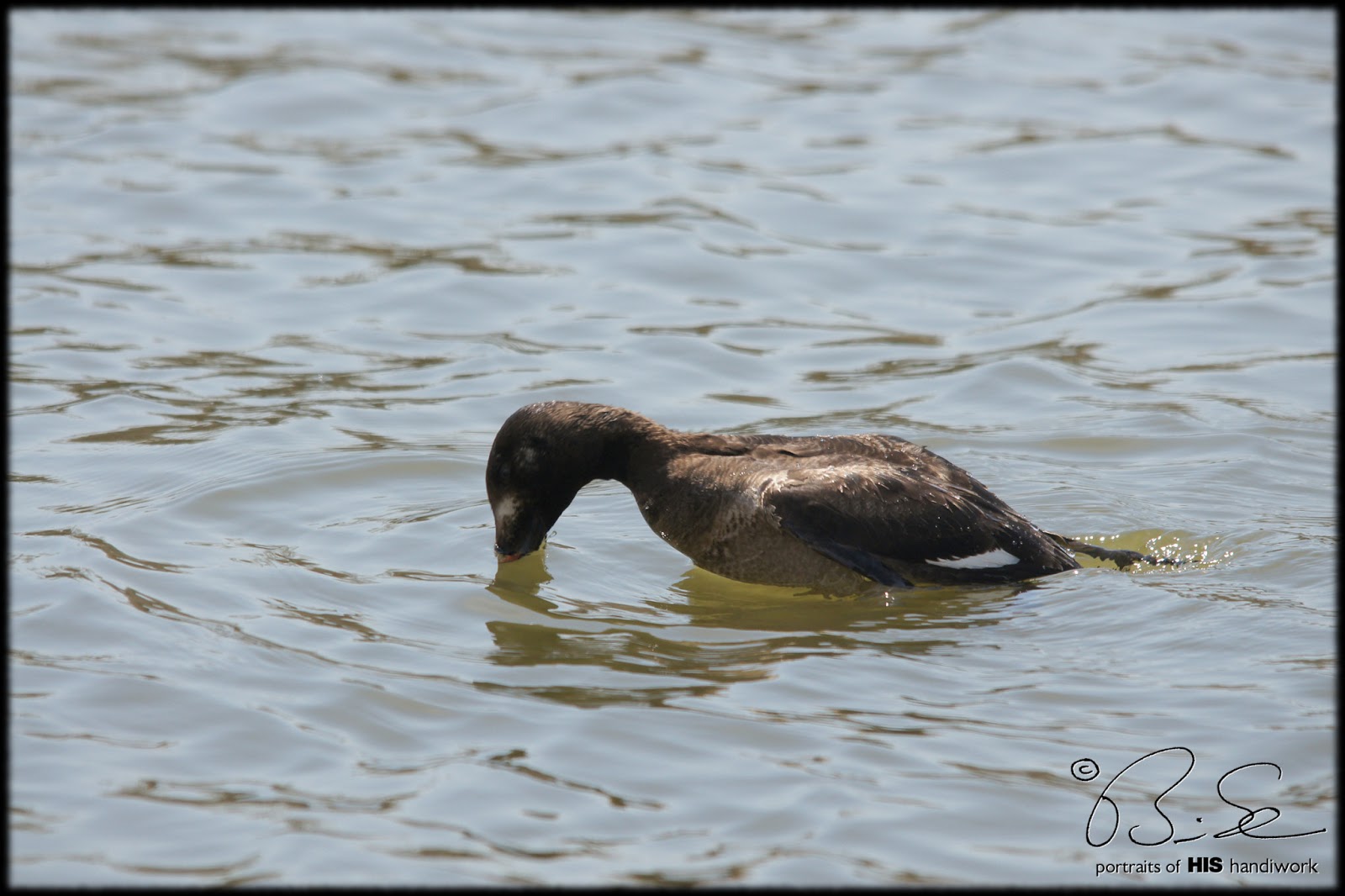
Last spring in February, at almost exactly the same location, I discovered my first White-winged Scoter.  This year, it was definitely not my first of the year, but I spotted a lone bird sleeping, bobbing in the gentle waves, not an apparent care evidenced by its bill tucked under a wing.  Once it had drifted close enough to the shore, it stretched and went to finding lunch of mussels and crustaceans along the water bottom.

White-winged Scoter

White-winged Scoter dive.

Standing on the armourstone blocks that edge the water, I could clearly see it swimming, hunting with great speed through the boulders and obstacles in the water just ahead of me only meters away. Then he would pop to the surface and crunch the foraged mussel or captured crayfish and swallow it shells and all.  They have powerful mussels in their crop which break up the shells of their meal and they break down and then digest the tough meals.


White-winged Scoter eating Crayfish.

White-winged Scoter eating mussel.

Keep enjoying HIS handiwork!

Sunday, August 19, 2012

Shots from the Lodge Part 3

This is my last post of three (part 1, part 2) from our family vacation up north at the cottage.  This time I am going to keep my commentary short and just let you enjoy more pictures than my ramblings.  I have a few other posts in the queue from a couple other picture taking opportunities... and I don't have a lot of time to type up something long here.

American Bullfrog

Ant carrying grasshopper leg.

I wonder what the weight ratio is of cargo to carrier?

Eastern Chipmunk

The next two pictures aren't the clearest, but I managed to capture this Chickadee hanging on a leaf which had been modified into a home by some insect.  It got the bug (larvae?) out and you can just see it in the second picture.  (click on the picture to see it larger)

Black-capped Chickadee -
foraging in rolled up leaf 

Black-capped Chickadee with bug

Life bird # 96 was found in the same Birch tree as the chickadees, busy searching not the leaves, but the crevices and crannies of the rough bark.  I've seen many White-breasted Nuthatches since starting this hobby, and it was nice to finally see its cousin.

Red-breasted Nuthatch 

Here's life bird #97, last of the cottage birds... a Hermit Thrush.  I'm quite sure that is what it is anyway.  The side shots weren't clear enough for posting, but from them I believe I have the right ID.

Hermit Thrush

This Red Squirrel wasn't shy - once it noticed me, it set up a ruckus and came directly for me through the trees, and stopped about 4m away and scolded me soundly!

Red Squirrel

Right around the lodge, the grounds are very sandy and there were many, many little excavated holes from these little Sand Wasps.  They dig their holes in the sand like a dog, flinging the sand quite a distance between their legs.  They are digging burrows where they will bring prey (other bugs) which will be come the food for the larvae from eggs they lay underground.

Sand Wasp digging a burrow - you can just see the sand flying.

Slaty Skimmer Dragonfly

The next picture represents some fun, but also the loss of some Uncle points with some of my nieces.  My nephew John-Michael and I were wandering around the edge of the land and noticed a large Smallmouth Bass protecting a whole school of its young.  We caught a Leopard frog and I tried to take some pictures of it.  Unfortunately, that's easier said than done, and more than few frogs gave their lives for the cause.  My conscience was appeased by the small dent in the frog population this would make, but my nieces did not agree with this.

Smallmouth Bass catching Leopard Frog


Just an interesting shot showing how waves (the physics ones too!)
actually bend around an obstruction.

Fuzzy juvenile Loons with parent in the background.

Tawny Crescent Butterfly

Eyed  Brown Butterfly

One thing I added to my wildlife list was a beaver.  There have been beavers on the lake in the past, but this time we were able to follow one in the canoe.  I was out with the boys sans camera, so never got any pictures.  He seemed to almost be enjoying the game and popped up either side of the canoe numerous times.

That ends the summer version of the Lodge shots.  We hope to go back there in the fall with some friends and family and we'll see what we see then.