Showing posts with label babies. Show all posts

Tuesday, June 5, 2012

The Bees and the Birds

No worries, this is not a "birds and the bees" post.  I changed the order for a reason.

Neighbouring two sides of our place is church property. On one side is a parking lot on which our kids are all one by one learning to trust that two wheels will in fact hold them up. Behind us is a very beautiful garden full of flowering perennials and trees.  We get to enjoy the benefit of the view with someone else maintaining it. There is always lots of  bird activity, and although mostly of the common kind, it's still fun on a Sunday afternoon when the rain stops and the sun peeps out to see what is there to see. I had noticed lately a pair of Cardinals persistently perching and singing and frequently giving off their "tink" alarm calls. It seemed very likely that there was a nest in the area. Until a couple days ago, my search had not been successful. I found it in a standard of some sort in the middle of the garden with only one young one in the nest.  

View of the gardens from our backyard (quickly snapped on my new phone)


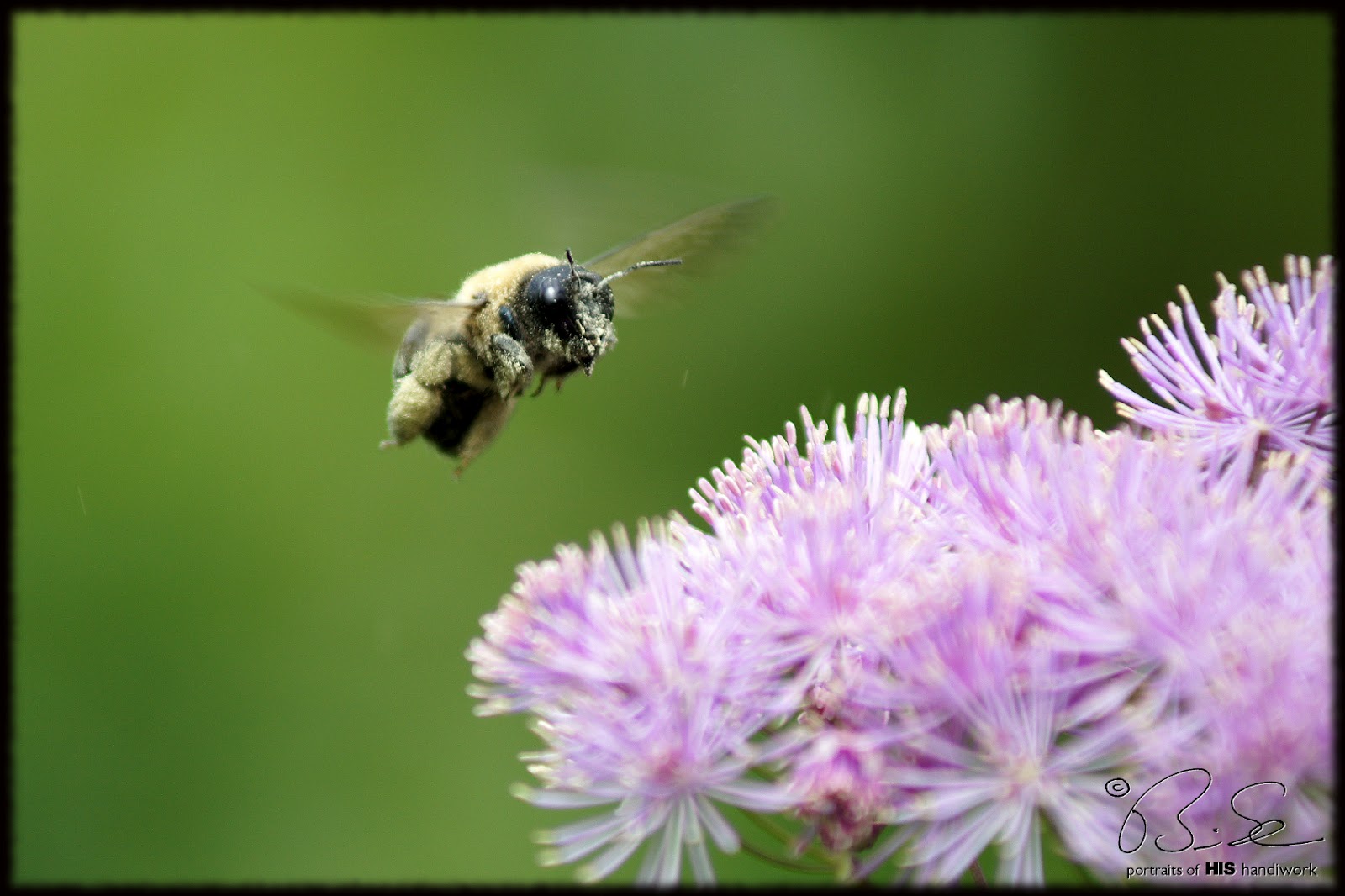
But, since the order of my post title was purposely switched, I have to show some bumblebee pictures first. This bumblebee is loaded with pollen.  In the first picture you can see the pollen flying off it in the air as it had just "settled" down on this location.


Bumblebee laden with pollen - you can see the pollen in the air above

Bumblebee on Greater Meadow Rue


When I got back out on Sunday to try and capture a picture or two of the Carndinal chicks in the nest, they were no longer there.  I followed the high pitched peeps, and finally located two fledglings in the near by trees and cedar hedge.  They were already flying quite well and seemed to be confident in their ability to wing away, letting me get pretty close before putting some distance between us.

Fledgling Cardinal in Linden Tree
"What YOU lookin' at?"

Cardinal Fledgling in Cedar Hedge

Fledgling Cardinal
(you can see the ear openings just behind and below the eye)

Here are the parents, who surprisingly, were not very agitated by my presence, allowing me to get some pictures without feeling too guilty about stressing the little family out very much.

female Cardinal in rose bush

male Cardinal in Redbud Tree

Wednesday, May 23, 2012

Cranes and Links

I went to Grass Lake again the other Sunday, hoping to catch the Sandhill Crane colt before it can fly and the parents start traipsing around the country side foraging through the hay fields and grazed, hilly pastures where they like to wander.

This adult was already checking out this alfalfa field, possibly scoping for the future... I was able to get relatively close.

Sandhill Crane in alfalfa field with lots of dandelions

Sandhill Crane takeoff
The colt and it's noisy parents were there, however, the young one was never very well in view.  Not surprising, but I had hoped it would repeat the nice show it had put on the week before, wandering into the water a little.


Sandhill Crane colt and adult pair

Sandhill Crane trumpeting
The cranes must have been near a Red-winged Blackbird nest, because one was very persistent in verbally and physically making it known that the cranes were not welcome there.  The bird would often land and sit on it's back, pecking away until a jab of the long, pointy bill would send the bird circling to start the aerial assault again.

Red-winged Blackbird pestering Sandhill Crane
Red-winged Blackbird assault
This Red-winged Blackbird was more content to put on a display for some hidden female somewhere.

Red-winged Blackbird

Here's my birding buddy for the afternoon...

Justin!

The Eastern Meadowlarks were singing away again, but what got my attention this time was a very unique call... Bobolink!  They are a provincially threatened bird, and it's a new life bird for me.  The call is described as being "bubbly" which sort of describes it.  It almost has a tight echo built into the sound.  Hard to describe but when you hear it, it's hard to forget that ID.  

Male Bobolink still in breeding plumage.

There were at least 5 or 6 of them flying around, appearing out of the long grass as I walked around.  They nest on the ground so I was sure to be careful of not stepping on anything.  They would fly up out of the grass, circle me a few times and the drop down to the cover of the long blades, leaving just a dull yellow head barely visible.

Bobolink collage - in flight

Bobolinks migrate a huge distance.  Travelling from their summer region of the northern states and southern parts of the provinces, down to central South America.

Bobolink in flight

I have to say, Grass Lake has been quite the spot to visit.  It's not far from my house, and somewhat secluded.  I'd love to explore the back part of the lake more when there is more time than I usually have between our church services.  My brother Dan will want to join me on that I'm sure.

Friday, April 6, 2012

Great Horned Owl and Young

We headed to my sister-in-law and brother-in-law's place for the afternoon today, and enjoyed the warm sun on the deck while the kids played with their cousins leaving us to a great visit.  Being situated in a beautiful spot half way up the Niagara Escarpment, I got distracted often by the many Turkey Vultures lazily circling the bright blue sky, often close overhead.  When I finally got the camera out, they decided to keep their distance.  Earlier a pair of Red-tailed hawks had landed close by in the crown of a spruce close by, calling to each other with their famous forlorn but piercing cry.  Of note, this cry is what you almost always hear in the movies, even if the bird is an eagle or other raptor.  

Great Horned Owl nest - as close as we could get from the top of  a ridge.

At one point Jer mentioned he had heard of an owl nest down the road and thought he knew the general location.  With no need to ask me twice, we headed off to see if it could be found.  With little effort, the nest was spotted about 50m from the road.  The large stick built nest was in the crotch of a large tree centred in the middle of a ravine the road followed.  Almost right away we saw movement in the nest.  Then, the sighting of characteristic, widely spaced tufts and the size of the bird produced the excitement of knowing it was a Great Horned Owl!

Great Horned Owl nest with young

I've only been sure of seeing an owl twice before in my life, both only being a silhouette as I drove in early morning.  One was perched on a road sign and the other on a hydro line.   The latter I had enough of a view to be quite certain it was a Great Horned Owl, indicators again being the "ear" tufts and size.  The only other time I believe an owl crossed my path was in very late dusk, also driving, when I saw a large bird glided a great distance across the road from one field to another, and the shape just seemed different than what my brain is used to registering as a hawk.

But back to today, even more reason for excitement was viewing confirmation on the zoomed in camera preview that there was at least one young one in the nest.  The white fluffy down, and another set of big yellow eyes was in the photo.  With the sun behind the nest, it was hard to see clearly though.

Great Horned Owl Nest 

To get a little closer view from the opposite bank and avoid the back-lit condition from the road, we crossed the small creek that calls the ravine home and crested the ridge in a farmer's field where we had a nicely lit view of two young owls with a huge parent keeping a watchful eye on us.  At one point while I had my camera glued to my eye, Jer saw a large shadow quietly but swiftly move through the forest and stop as something landed in a large tree off to the side.  We couldn't locate it, but I wonder if it was the mate which may have been drawn in by Jeremy's pretty good whistling imitation of a Red-tailed Hawk.

Cropped image showing the two young owls.

Great Horned Owl Fledglings

This was a pretty exciting find for me.  I've long hoped to see an owl in enough light to clearly see it and get some pictures, but never dreamt I'd get to see young ones as well.  If I lived closer to the location, I'd love to camp out on the ravine's edge and watch the activities of this owl family.  We couldn't stay long as the rowdy young in the relative's "nest" up the road would soon revolt should a meal not be provided there. With Jer on the soon fired up BBQ, a great meal was enjoyed with great visiting.  Thanks for making my day with the owl outing Jer... Oh, and thanks for having us over for the visit Maria - we enjoyed that too!


Tuesday, July 12, 2011

American Robin Nest


Another nest in the backyard.  This one, a Robin's nest, got very close to coming to its end as it was in our wagelia bush which I was trimming drastically this past Saturday.  Just as close was the female robin that flew out just as the hedge trimmer passed by the nest which ended up being only about 6" in from where I cropped the bush to.  It had stayed there, bravely, till the last minute.

Four "robin's blue" eggs.
Somehow what I didn't notice till editing the pictures this evening, was that one of the eggs already had a small peck hole in it (bottom right egg).  I have still to see a baby bird hatch from beginning to end.  Well, Sunday was a full day and I never ended up going back up to look.  This evening, there were already two little ones hatched, and... one was just crackin' out of its already split egg.  

Last push.

Mom?

Hard hat?

Already looking for food.

Beat!

Robins are a big part of the summer scene here, always hunting across our grassy lawns, tilting their heads and then straining against the worm's desperate grips on the last inch of dirt.  Robins breed their two or three broods of young each summer up in Canada and northern US before heading south again.  We see them often, and usually are falling asleep to the males singing away in the warm, summer evenings, and then having them waking us up at 4am just outside the window left open to let in the cool evening air.  Living in Southern Ontario, you're quite likely to have seen a nest as they will top your outside porch light, arbour, or many other places within easy view.

You can see the eye slits staring to develop to allow this chick to see in about 4 days.

But here are a few facts you may not have know about this common bird:
- Robins aren't listening for the worms while they're out on your lawn.  They're tilting their heads only to carefully see straight on with one eye for the wriggle in the ground as the worm comes up to the surface.  Robin's eyes don't pivot like ours.  They will "pounce" to get into the ground a bit around the worm that might only be slightly protruding to get a good grip.  They may also "stamp" the grass to try and make worms in near vicinity give themselves away and move when they feel the vibration.
- Worms only make up about a fifth of Robins' diet.  They eat lots of other insects and berries as well.
- You can tell if a male Robin is breeding if it has extra-black feathers on its head, darker than the rest of its feathers.

We'll see if the other egg will wait to hatch tomorrow morning and see if I catch it.  Not likely!


Friday, July 8, 2011

Long Point Provincial Park 2

Here is the second part of the Long Point post...

I spent one afternoon walking the campground and a bit of the beach in search of birds who were going to stay close enough to be photographed.  I wasn't terribly successful on that trek.  I did get to see a bird I had never seen before - an Alder Flycatcher landed for a brief moment a little ways away, though still quite far away for a 300mm lens (I cropped the picture significantly.)  It's not the greatest shot, but thought I'd put it in anyways.  I should mention that it's possible that it could be a Willow Flycatcher - according to one of the websites I use to figure out what I've seen, you can only really tell the difference by their songs - which I didn't hear and wouldn't have had a clue which one I was hearing.  Because at Long Point it's full of Poplars and Alder trees, I'm going to assume it was an Alder Flycatcher.

Alder Flycatcher a way out there.
I also saw Cedar Waxwing, Baltimore Oriole, Yellow Warbler on this jaunt, but not close enough to get any great shots.  The ironic thing is, the rest of the pictures I got (except for some Oriole shots at the end of this post), were all right by the comfort station.  One of the Park Rangers noted, as I was standing their taking pictures, that every year they have multiple nests around both the main comfort stations at the park.  Interesting considering all the people and pet traffic around.

The most fun, but hardest to get a good shot of, was a tiny Yellow Warbler nest with four little ones.   No matter which side I tried to take the picture from, angling to get a view where the delivery of the meal would be in view, the bird would choose the other side of the little spruce the nest was at the centre of.  I did manage to get a few shots, but nothing straight on.

Yellow Warbler with plenty of bugs trying to stay just out of sight.

Somehow they know food is coming and jostle for position.

Two of the four young ones. They're about 50cm small at this point.

I did get this shot of a baby getting fed by a Yellow Warbler.  Only thing is, I'm not completely convinced this is a Yellow Warbler fledgling.  It seems bigger than the adult, and later on, I'm wondering if I saw a Baltimore Oriole trying to feed the same chick.  Anyone care to enlighten me who knows?

Yellow Warbler feeding .... ???

At the same location near the comfort station was this male Baltimore Oriole.  Although it was a day later, as I just noted, I believe it was feeding the same chick that I saw in the picture above.  I know that Cuckoos and Brown-headed Cowbirds are known to lay eggs in other bird's nests, leaving the nest owner to raise their young.  I don't think Baltimore Orioles do this though - I couldn't find anything on the internet which made me think so.

Baltimore Oriole with caterpillars.
One of our friends noticed a Baltimore Oriole nest high above in the trees near their site.  I have never seen one before.  Baltimore Orioles weave a hanging nest, the bottom a nice round ball, hollow in side with an opening on one side on top.  It's usually near the end of long branches for added protection.  Baltimore Orioles song sounds somewhat like a cardinal's, both in tone, and sometimes, somewhat in it's melody.

Baltimore Oriole nest.
The nest was quite high up in the tree. Having been treated to getting close at the Yellow Warbler nest, I tried to get closer by standing up on a picnic table - likely looking foolish to the rest of the group.  Oh well.  At least I stopped at only one table, and didn't stack another.  Amazing though how such a little bird has been given the ability to create such a masterpiece with pretty much a completely round nest.  I wonder how they get it started.

Male Baltimore Oriole feeding young - you can
just see the beak of one on the bottom of the nest.

Female Baltimore Oriole

I made one trek into the long grass lands towards the inner bays where there are acres of marshy areas, to see what there was to see.  Pretty dumb of me though.  Long Point is known for its ticks.  Lyme disease is known to be spread by female Deer Ticks which are found there.  Although it's apparently not quite the certainty that some make it out to be that you'll get it easily, get sick, and die; it's quite easily treated if you catch it early....  I went out and thought, as long as I keep moving, surely they won't have much time to climb up my shoes and legs, etc.  Well, as you can see from the two pictures below (no birds, only flowers), I obviously did stop, and though not for that long, it was long enough.  At one point I looked down and found, without exaggerating, at least 10 ticks climbing up my legs.  They all came off rather easily, and I was confident they were all Wood Ticks (or dog ticks) as earlier that day we had found one similar on one of my sons, and the Rangers assured us it was not a Deer Tick but the former.  Deer Ticks are half the size, and easy to distinguish with a reddish body and black near and including it's head.  However, you should still be careful, and even though I was walking on a mown path, obviously they still were getting on quite easily.  Lesson learned.

At the price of 10 Ticks... some shots of flowers which I cannot name.  My dear mother is the wild flower expert in our family. Maybe she will be able to identify these.  The first one looks like almost an orchid they way the flowers are arranged on the stem, and the long leaves in the background of the picture.

Wild Sweet Pea.
(Thanks to Karen for the info on the flowers!)
I'm guessing this is some sort of wild iris?

Wild Iris

Even though we were by the beach, I saw absolutely no shore birds other than the very common Ring-billed Gull.  The beach there has shrunk considerably with what must be higher water levels and possibly some erosion from some storms?  Didn't leave enough room for some good beach volleyball.  

A great weekend - till next year?

Friday, June 24, 2011

Going for a Ride

Well, here is a post I was looking forward to putting up for a while... 
I think this was one of my favourite lunch hours so far at Bayfront Park.
Enjoy!

The "ugly" duckling?

Proud momma with five cygnets.

Pile on mom!!

Wait for me!

High, dry, and cozy.

Best seat on the ride.

Starting to preen right away.

Dozing off.

Taking up the rear.


the Cob just up from a snack.
Here is some more information about swans on a neat website I found.  Lots of interesting facts about swans.  A few highlights that you might not have known (or may never care about):
- A swan has 23 vertebrae in that long graceful neck
- Cygnets have to peck for almost a whole day at the egg with the "egg tooth" on their little bills before hatching.  No wonder they look completely wearied when they hatch, wobbling all over the place.
The male is called a "cob", and the female a "pen".
- The cob typically can be distinguished as the larger of the two, and also has a larger knob at the base of its beak.

A beautifully designed bird, enjoyable to watch with their young.