Showing posts with label Ring-billed Gull. Show all posts

Sunday, July 20, 2014

Grass Lake and West Shore of Hamilton Harbour

The very first day of June was a Sunday and I went to Grass Lake for a quiet afternoon. I started out walking on the south side of the 570 AM antenna field where five huge metal spires send the radio signal at the KW Cambridge area.  I met one of the technicians there one evening last summer and chatted with him for hours into the darkness. It was a very interesting chat as he explained lots of the technical information about the antennas and system. The first two (southern) towers actually cancel out background signals, the middle one sends out the radio signal, and then the last two (northern) towers repeat and boost the signal.

Being early afternoon, there wasn't a lot of bird activity, but a Tree Swallow perched for a picture for me not far from its nest box in the radio field.

male Tree Swallow

There were a few pairs of Bobolinks flying around, but not as many as I've seen in the past. I hope that's only because they were all attending nests or young.  But I finally saw as well as got a half decent photo of a female. I'd only ever seen the males before. I still love hearing the completely unique call of these birds. It is such a un-birdlike sound. I've noticed recently though, that Red-winged Blackbirds share slightly in that very different sound characteristic. Has anyone else noticed or heard it too?

female Bobolink

Along the same fence line, you are always sure to see some of the Savannah Sparrow pairs.  They, of all the birds in this area will allow you to get closest.  Moving slowly but surely, they often let me get quite close. It's interesting how different birds characteristically allow approximately the same distance until they are no longer comfortable with your approach.

Savannah Sparrow

Walking towards Grass Lake, a House wren was signing heartily in a small patch of mostly dead Pine Trees.

House Wren

As I walked along the dirt road which sweeps around the water's edge of the shallow, grassy lake, a pair of Sandhill Cranes quietly glided in. I was too slow on the draw and missed getting any pictures.  They landed quite far back in where the deeper, open water is and proceeded to make their presence known to the rest of the lake with their loud calls and comical head movements.

distant Sandhill Cranes

I got startled as I walked along the road edge when suddenly, something large enough to move a significant amount of the long grass at the top of the bank moved quickly towards the water's edge.  The creature turned out to be a large snapping turtle and made a mad slide down the bank, crashing into small trees and branches as it headed for the cover of the water. I went back to the spot and noticed a circular track it had made in the grass with an untouched area of grass left in the middle about a foot and half in diameter. Being early June, it's possible it was looking for a nest site, though it didn't seem like a prime location given a hard packed gravel shoulder with grass roots reinforcing it all.  Then again, those stocky legs and sharp claws would likely suit that task well.

I had heard that there was a Brown Thrasher nesting on the north west end of the lake, but saw no sign of the nest nor the bird. I headed home and decided to leave the opposite directly I usually do, and though not intentionally, past the supposed Thrasher location.  Just as I passed, a big Brown Thrasher flew right in front of me and swept up and landed in a dead tree.  Quickly stopping and trying to get my window down and camera up and ready was too long for the bird to get wary and it flew. I got out and after some searching finally found it way up in a big tree.  I climbed a bank for a better view and still got some nice pictures of life bird #204.

Brown Thrasher

Later that week, I headed out early in the morning before work to the east shore of Hamilton Harbour close 1to the Canadian Centre for Inland Waters on the west side of the QEW.  There had been reports of American Pelicans regularly visiting the man made islands for a number of days and I thought I'd see if I could get some pictures in the early morning sun. Turns out I waited too long and they were not reported again.  But I got to see the large colony of Caspian Terns nesting there mixed among the Ring-billed Gulls doing the same.  You can just make out the fuzzy, well camouflaged young of both species in the pictures.  I'm not sure what the Tern in the middle was doing. It had caught a nice little fish, but was just standing in the same spot for quite a while.  I'm surprised it was not attacked by the other birds around it and either forced to down it quickly, fly away to protect his catch, or drop it and flee. But none of those things happened and I'm not sure what it was waiting for.

nesting Caspian Terns and Ring-billed Gulls

Sharing the same island, but perched on the trees that are barely surviving the acidic anointing they are receiving are the Double-crested Cormorants also attending to young.

nesting Double-crested Cormorant
I was standing on a narrow beach that was just beside a flight path where, over and over again, Cormorants were swooping down from just crossing the QEW bridge for a short, low approach over the water to the island. Many were still bringing nesting material and after many pictures I finally got a half decent one.

Double-crested Cormorant with nesting material

Until next time...
Keep enjoying HIS handiwork!

Monday, July 1, 2013

Deafening!!!

I had a site visit to do a couple weeks ago and swung by Eastport Drive where I hoped to catch some sights of young Sea Gulls and Cormorants.  I should have brought ear plugs!  Wow, it is incredibly loud!

Ring-Billed Gull on nest.

The only immediate evidence of the Ring-Billed Gull colony are a huge row of sentinels along the jersey barrier.  I should have taken a picture of this.  On the other side, amongst the weeds and rip-rap down to the water's edge of Hamilton Harbour are thousands of gull nests with spacings of often less then a meter.  There are gulls of all stages ranging from eggs to larger, soon to fledge young.  Some eggs were being tended to by sitting parents, some were abandoned, and still others had holes evidencing sabotage by other gulls or having been eaten by some predator.


Ring-Billed gull eggs.


Ring-Billed Gull chick.

Fish meal for a Ring-Billed Gull.

As I mentioned, the location is also known for the huge colony of Double-Created Cormorants.  Below you can see a small taste of the thousands or birds.

Eastport Drive Colony

Cormorants feed their young regurgitated food.  This can't be a pleasant way to get your lunch!!


Double-Crested Cormorant feeding its young.  You can
just see the bright blue inside of its mouth here.

Double-Crested Cormorant nest with young.

Double-Crested Cormorant

The location is also quite reliable for seeing Black-Crowned Night Herons.  They are more shy than the seagulls who let you walk within a meter or two and the cormorants.  There were three hidden in the trees, behind vegetation which remains on the trees closest to the road where the cormorant's feces aren't dropped.  There feces are deadly to the trees they nest in.

Black-Crowned Night-Heron

Being close to the Burlington Lift Bridge, I stopped there briefly to see if the in my short time left I could spot the Peregrine Falcons.  There were a few other Falcon watchers there and I had timed my visit well (obviously without knowing) as one of the female young had just fledged that morning.  She had taken up hiding inside one of the beams but we found her perched beside an opening.  Though not a picturesque location, it was exciting to see this amazing creature up close.  Turns out though, that however the young bird got in there, it wasn't a simple matter of getting out.  If you're interested, you can read about the ordeal here.  Good news is, all ended well.

female fledgling Peregrine Falcon

 One of the adults was seemingly uninterested in the plight of its offspring was way up in one of the big hydro towers preening away.

Peregrine Falcon adult preening in the hydro tower on the Hamilton side.

I am getting really behind on my posts.  I just checked the date of these pictures and it was back on June 4th!  My posts have fallen to almost a month behind!  Oh well.  More pictures to come.

Keep enjoying His handiwork!

Saturday, April 20, 2013

New Colours - Blue and Ruby

Over the last week or so, I was eager to make a few outings with the newness of my lens still keeping me eager to see what it could do.  I made a trip LaSalle first, hoping to see an Eared Grebe which had been reported there.  But it must have travelled on, because it was not there and I saw no more postings about it afterwards.  I walked along the small boardwalk and was treated to a pair Carolina Wrens who were uncharacteristically comfortable with my presence.  Slowly I raised my lens and was greeted with the message "NO CARD".  Aghhh!  I was "forced" to enjoy nature without electronics in between!  How terrible.

The next trip out I headed to Valley Inn Road with reports of a number of interesting birds.  Unfortunately the ponds were rather quiet, at first seeming to only leave a few pairs of Northern Shovelers.  But then I spotted a GreenBlue-winged Teal which made the trip rewarding, adding life bird number 119 to the list.  It was not terribly close so I didn't get really good looks and required some cropped photos for posting.

(Thanks to Dwayne for correcting my mess-up on the bird ID! They don't really even look alike and somehow the name colour got switched in my head.)


male Blue-winged Teal (centre) with Northern Shovelor pair.

male Blue-winged Teal and female Northern Shovelor

A Ring-billed Gull was floating in the water not far from where I was sitting with the hopes that the Green-winged Teal would meander close.  Suddenly, from its floating mode, it started diving which isn't typical for gulls.  A number of times it did it and then finally came up with a catch - a big juicy snail.


Ring-billed Gull with snail catch.


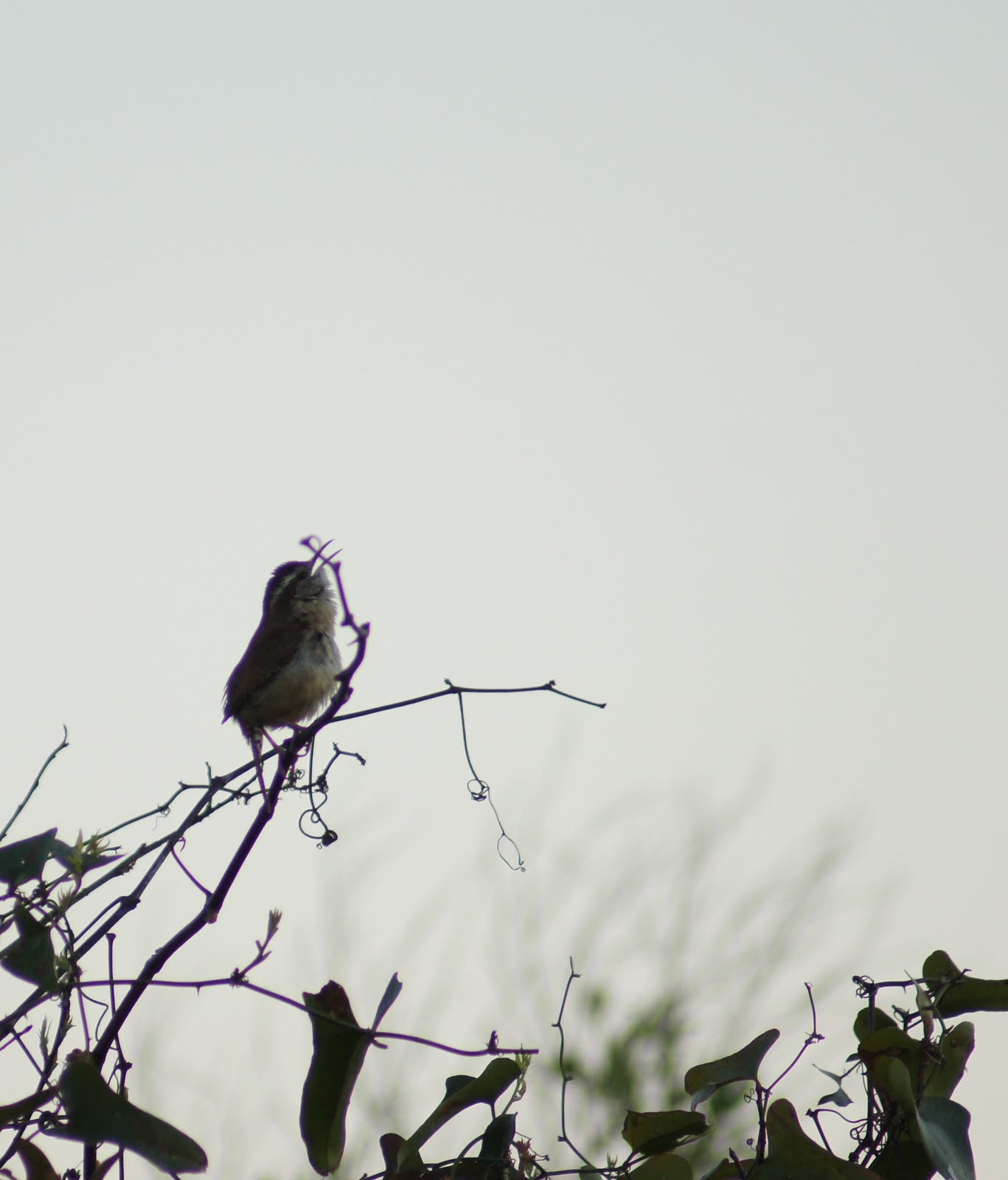
My next outing I headed back to LaSalle, hoping but not really expecting to see the brave pair of Wrens again.  Not in the same location, but I believe I did in fact find them!  The male was singing its heart out as I walked the trail past the boardwalk to the east.

Carolina Wren

Carolina Wren with Northern Cardinal.

Carolina Wren in full song.

Now for a tale on learning humility.  I've been enjoying the birding/photography hobby for a long 28 months or so now.  In months it sound longer than saying it as just over two years.  A few people walking along the trail were wondering what birds I was enjoying and I gladly pointed out the wrens and White-throated Sparrow all skittering through the leaves in the underbrush at that moment.  I was glad to share my knowledge and be able to point out some of the birds I have learned to some apparently obviously novice but interested walkers.  Good of me really to be so kind! A smaller bird which I had actually noticed earlier in the background to my Wren watching was noticed by one of the ladies and she asked what it was.  I over-confidently stated it was only a female Goldfinch.  No, she was not sure that it was.  I gently, but still a confidently, told her I thought it was.  Again, she said, no, she didn't think so.


Ruby-crowned Kinglet

I had taken a shot or two of the same bird out in the distance earlier, actually thinking it strange that a Goldfinch was making its way thought the lower portions of the under brush.  A grainy zoom in check on the playback had me thinking though that that is all it was.  I had gone back to watching the wrens again.
 

Rub-crowned Kinglet showing off its bright crown.
 
With the lady, I followed the bird in question as it was now closer to the trail.  A sudden bright flash of bright ruby red made my ID immediately known as completely wrong.  Ruby-crowned Kinglet we voiced together in unison.  I looked over and immediately had to acknowledge my previous identification as quite wrong.  Looking back, I should have known the olive green and less pronounced wing bands were the clues!  Humble pie!!  Turns out the lady's son is an avid birder and she's picked up the knowledge to ID a bird or two from a number of years under his tutelage...  I had to apologize for my rather bold but incorrect identification.  I admitted I didn't mind too much being wrong, as it was a new life bird for me... #120.


This little bird is one of the the smallest  North American birds and we are on the southern fringe of its nesting range.  They are extremely active little birds, sharing the characteristic of being constantly in motion with their cousins the Golden-crowned Kinglets.  They are finding insects hiding in corners and edges of buds and bark of the slender branches of trees.  This bird must have been resting for bit of a breather as I was able to get quite a few shots before it moved on again.


Ruby-crowned Kinglet


The  White-throated Sparrow I had mentioned earlier was not cooperating at all for a picture.  It was carefully sticking to the densest sections of the brush.  Interestingly, it was constantly singing its "Oh Sweet Canada Canada" call, but very quietly, all along its foraging journey.  I wonder why it was calling so quietly.  I finally got a chance for a few pictures when it too stopped for a brief break.

White-throated Sparrow.

One thing I discovered I had done on this trip was to forget to turn off my SteadyShot on the camera - a feature of the Sony cameras which provides image stabilization in the body.  The new lens has its own optical stabilization which is better than the in body option.  And when the two are on together, they are actually often fighting each other.  Since this is a shared camera for the around the house photos, I'll have to remember to switch that function off and then back on for every outing.

Thursday, February 2, 2012

Long-tailed Duck

I have had no time for any birding at all in a long time... my dear wife is suffering through her very rough pregnancy leaving me to pretend to be a mom before and after work. I tell you, you sure notice how much your wife does when she's down and out for weeks on end. I'm not going to pretend I'm even keeping up the standard she does, and I'm getting lots of help from great friends at our church with the kids and meals.  I don't say it often enough - Thanks for all you normally do to keep this house running and raising our kids dear!!

Long-tailed Duck
I had to go to Spencer Smith Park in Burlington to review the park grounds and take pictures for a proposal I'm working on with others from our firm.  While walking around to take shots of the grading, drainage and the promenades there, I saw the usual Canadian Geese and some Mute Swans, but also a number of Long-tailed Ducks.  This is a new bird for me, and not common in Southern Ontario as it's an arctic bird.  It's an attractive bird and also has a very distinct call, which as far as I know, is unusual for waterfowl which don't usually have much more than a single note or sound.  Here is a link to what they sound like.

Correction - The Long-tailed Duck seems to have grown to very large wintering numbers in this area since the zebra mussel's appearance in the Great Lakes.  The range maps I looked at online are either out of date or... well, I'm not sure.  I've looked at some more and now see their range extends below the lakes and into NE USA. Thanks to those who emailed or commented to put me straight. ;)

Male and Female Long-tailed Duck

This seagull is losing it's juvenile stage and decided to put on a show for me while I was taking pictures of the lower promenade.  I had the point and shoot camera from work but got some decent pictures still.

Ring-billed Gull

Till next time... :)


Wednesday, September 28, 2011

Older Photos

I was going through some of my old photos and doing some house keeping.  I found a few photos from previous trips to Bayfront Park that I hadn't posted and thought I'd share them.  I haven't done much of getting out to photograph anything of late.  Life is quite busy at the moment!

Mute Swan taking off.
I enjoy watching terns make their hunting circuits over the water.  There is something about how they fly that I like.  Their wing strokes are different from gulls, more definite and crisp with a kind of movement that somehow brings the word "lilt" to mind.  It seems so effortless, and you can see them sure ahead with every stroke.  They like to set up a number of  loops which they patrol a few times, and switching between them periodically.  When a small fish is seen close enough to the surface, they tuck and plummet into the water to pursue the prey.

Common Tern looking for lunch.

Sunday, May 22, 2011

Myrtle Beach - March 2011 Part 1

In March, Holly and I and kids joined good friends Kevin and Carole for a vacation in Myrtle Beach, SC.  It was a great time with lots of games, swimming at the water park, and once for me in the ocean on the boogie board.  Pretty cool and rainy a lot of the time, but we had a great time.

There were many different birds down south to try and capture.  I'll split it up into two posts: one around the hotel and the other on a trip I made to Huntington Beach State Park.


Northern Mocking Bird,
Mocking birds are quite common in the southern states.  We have them here in Southern Ontario too - I see one by my office every year - but not nearly as common.  It's amazing how they will sing, on and on.  Mocking birds are famous for their ability to learn other bird's short songs and repeat them, often learning as many as 200 different melodies.  They have even been known to copy car alarms and other insect sounds.

Northern Mocking Bird

Laughing Gull

These Laughing Gulls are different from the usual Ring-billed gull which we are used to seeing in Southern Ontario.  They are smaller, and seem to stay in much larger groups.  One unique thing God created gulls able to do is to be able to drink sea water.  They're able to do this because they have glands which extract the salt. The salt is eliminated through their nostrils.

Jostling - Laughing Gulls

As with a most gulls, they can be quite vocal - these are no different.  They have bright orange-red interiors to their mouths.

Laughing Gulls

Flock of Laughing Gulls

Ring-billed Gull

Ring-billed Gull

I have not been able to figure out what kind these birds are. Their flight reminded me of a tern's, and they way they were cruising the waves trolling for fish, then diving in was also similar to a terns.  But their shape wasn't what I'm used to seeing in Southern Ontario for terns, and more gull like.

UPDATE
Turns out they are Bonaparte's Gulls in winter plumage.  I had assumed not as the rest of the huge group was in normal plumage.  Thanks for the help Karen.


Bonaparte Gulls in Winter plumage

Bonaparte Gulls in Winter plumage

Bonaparte Gulls in Winter plumage


House Finch, Yellow variant

Carolina Wren
These little wrens are hard to capture on camera.  They are a quick little bird that likes to stick in the thickety part of bushes and trees.  They love to sing and are known to have the loudest song per size of the bird.  Below is the only shot I could get of one singing.

Carolina Wren in full song.

More coming in the future of my remaining shots... shore birds and alligators...