Showing posts with label Spotted Sandpiper. Show all posts

Tuesday, June 11, 2013

Ignoring Close to Home

It's weird that somehow it always seems more exciting to try and bird somewhere a distance away from your own backyard. And although birding in the Hamilton area is well documented to be very productive, it doesn't mean there is nothing close to home to see and enjoy. Over the last few weeks there have been more than one occasion for that to be true.  There was my recent trip to a nearby farm which started as a firewood acquisition.  And the next opportunity also resulted because of getting more firewood.

I was on the south side of St. George cutting and lugging home a few cords from a huge, old Beech tree which the hydro company had taken down in a big wire protection campaign they did in the area.  While feeding the thirsty chainsaw or filling the trailer with wood, consistently I was hearing a persistent, unfamiliar bird call.  On my last load, I brought the camera with me and decided to push into the neighbouring woods which also backs on to an adjacent golf course.  But before I could circle in on the source, I heard and then spotted a Eastern Wood-Pewee.  Their distinctive "PEE-ah-WEE" call gives them away, but they are small and like the tree tops, so I've not gotten a close look before. This one seemed curious about me, so although not really close, I could get a nice look and some closer shots.

Eastern Wood-Pewee

Eastern Wood-Pewee

Ironically, my circling in on the original singer lead me back to where I started, and I finally found the little creature who had been singing along with my chainsaw all day.  It was a cute little House Wren (life bird #124 - I skipped this one).  Unfortunately my vantage of the bird was through other underbrush and I couldn't seem to get a good angle, so I had to switch to manual focus and in low light, that didn't prove to result in many good pictures that were in focus.

House Wren

One other sight I spotted was a thoroughly tapped Pine tree by a Sapsucker.  I had "borrowed" and posted a photo from another website previously when I saw my first Yellow-bellied Sapsucker, but now I have my own picture to share.


Yellow-bellied Sapsucker food site.

Again close to home, there is an old sewage lagoon from the old Carnation condense milk plant in St. George which has since been closed.  And the sewage lagoon has also been decommissioned and reduced to a small fraction of its original size.  They basically excavated a big outlet in the original banks they had constructed years ago and left a shallow area of water to remain.  The location was still suitable for a small group of about 10 Canada Geese, and a little mixed flock of shore birds.  About three or four Spotted Sandpipers were courting each other and wading along the water's edge.


Spotted Sandpiper
 
Spotted Sandpiper courting "chase"

There was also a small group of four Killdeer there, and they seemed to be very busy with a prolonged argument.  If it's possible to tell male and female, I certainly don't know, so I'm not sure if this was a territory or mating battle, but the four would all slowly approach on each other and then one would make an aggressive move on one of the other in the group and they'd all wing a short retreat back.  It was repeated over an over again.

Killdeer
  
Killdeer standoff

The next few pictures have been quite a mystery to me.  A few of you received emails from me asking for your advice.

Sanderling? female Semipalmated (l) and Least Sandpiper (r)
The bird on the right I'm confident is a Least Sandpiper.  The yellow legs, size, etc all clearly point to that ID.  But the bird on the left is another story.

Sanderling? female Semipalmated Sandpiper (l) and Least Sandipiper (r)


At first, I thought I had a Semipalmated Sandiper.  But the beak seemed too long, and too pointed.  Some of you suggested Western (I try not to get myself excited about rare finds, of which that would be for this area) so I didn't really consider it.White-rumped was also considered but discounted because the wings don't seem to pass the tail really.  I was leaning to a juvenile Western though after lots of looking on the web.  For good measure I thought I'd ask the Hamilton Birders Group, and it seems the consensus is that it's a juvenile or female Sanderling.  That does seem to fit best and be most likely, though I still feel like the beak looks to long.  So, to be conservative, I'll stick with that ID and forgo an exciting new life bird tick.

Sanderling? female Semipalmated Sandpiper searching for food on the water bottom.

Thanks to everyone (Dwayne, Peter, Caleb, Wayne, Gerry) for their input.  Although somewhat frustrating not being able to come out with a clear ID, I think I learned a number of "peep" traits that hopefully will help in IDing them better in the future.


UPDATE: I received an email this morning from Kevin McLaughlin (who I understand is more than qualified on peeps) that female Semipalmated Sandpipers are known to have beaks that are almost as long as the Western Sandpipers.  So, based on that new information, I think I have a firm ID and learned something new in the process.  Thanks Kevin.

And, the moral of this post is, don't ignore the little spots close to home... there's likely more bird life hanging out there than you might think, even if it doesn't seem so exotic to burn gas getting to somewhere "else".

Keep enjoying His handiwork!

Saturday, June 23, 2012

Drive-by Birding

On Tuesday I enjoyed seeing more birds than I had every expected, and it all turned out to be within a few paces from the same road - Hwy 5 between work and home. I had my camera along and ended up making lots of stops all with birds making an appearance.

Spotted Sandpiper reclaiming a caterpillar.

In the morning, I had to stop at a client's development site to check out where existing drainage ultimately is collected to.  I popped up an embankment to review the topography of the neighbouring Lafarge Gravel Pit which is being reclaimed with fill slowly being brought in.  A Spotted Sandpiper noisily protested my appearance and flitted away from a marshy area with its stuttering wingbeats.  When standing still, which is not often, their tail bobs down and up.  I had my camera with me that day and the bird dropped to the stony ground to reclaim a caterpillar I must have startled it into dropping.  Shortly later, it let me approach while pacing back and forth along a dead tree branch.  These Sandpipers don't follow the traditional roles in the animal kingdom with the female being the leader and the male assuming the responsibility of raising the young.

Spotted Sandpiper

I know I just shared a post about these beautiful butterflies, but I liked them enough to include here anyways.

Canadian Tiger Swallowtail Butterfly

Canadian Tiger Swallowtail Butterfly

A song sparrow was cheerfully singing a tall Ash tree overhead.

Song Sparrow

Our office was part of a Habitat for Humanity house project and sodded the yard and cleaned the house for an afternoon.  Only thing - the afternoon only took about an hour once we got going with the gang we brought.  The boss was generous and said he certainly didn't expect all us dirty sweaty folk to return to the office after working in the hot sun.  So I headed home, but decided to take the opportunity to stop at a few locations along the way home that I'd been eyeing.  Time for that hadn't been available when trying to get to work on time or home to a wife eager for relief from the crazy kids.

My first location was unplanned as I saw a Turkey Vulture in a field just west of Rock Chapel Road.  

Turkey Vulture
It was drinking at a shrinking puddle and warily let me approach somewhat closer than my road's edge vantage point.  It nicely stretched its wings which typically range five to six feet across.  When I tried to approach closer, it took off and headed for the hills.

Turkey Vulture wing stretch.

Interesting fact: If they think they are danger, Turkey Vultures will throw up, leaving an incredibly foul smelling deterrent (not surprising considering they eat rotting animal flesh) which makes the predator hesitate long enough for the vulture to make its get away.

Turkey Vulture

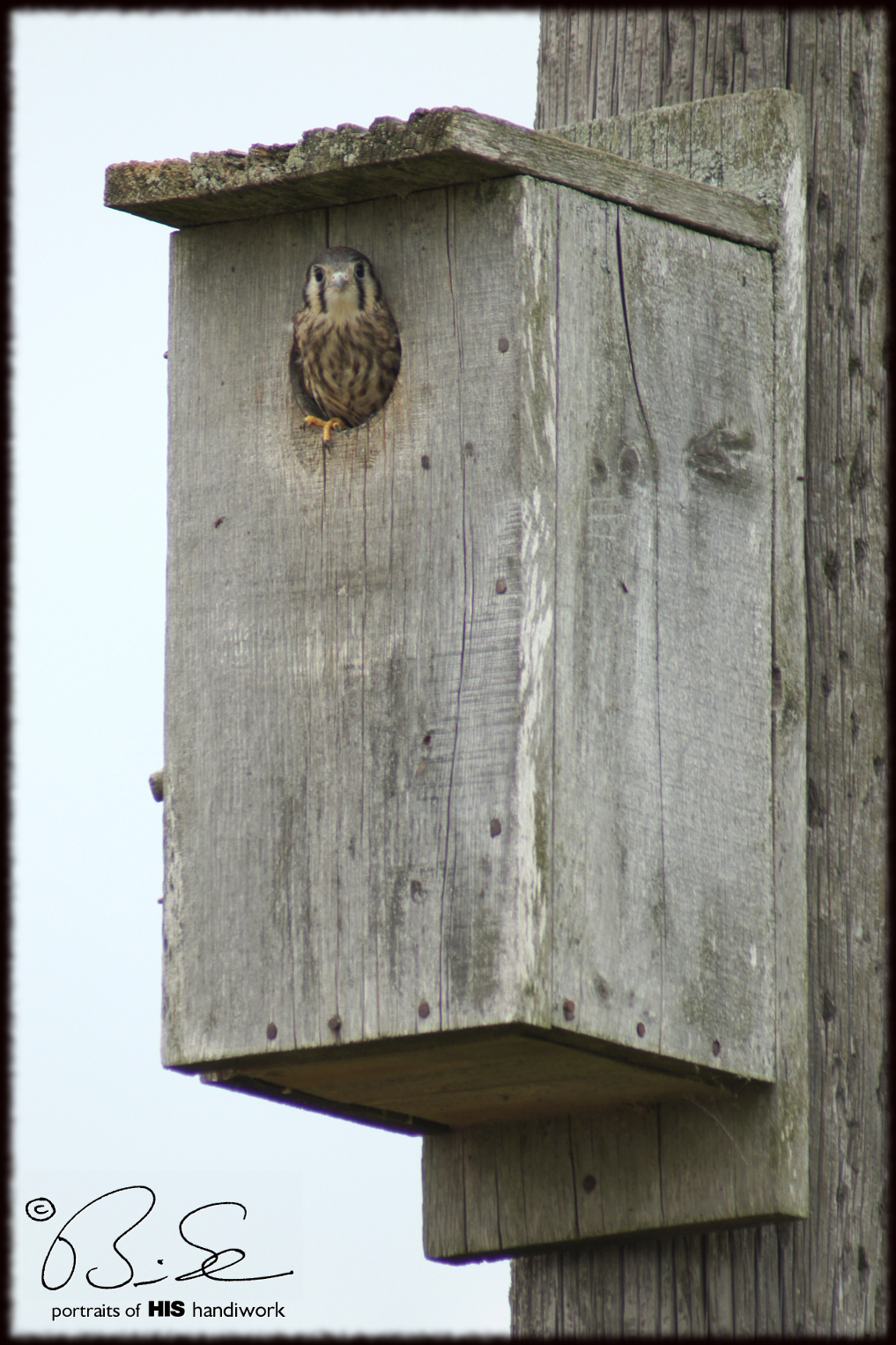
My next stopped was a planned location - a bird box on a hydro pole just west of Peter's Corners (intersection of Hwys 8, 52 and 5).  Early one morning I spotted a bird atop a nesting box and actually had wondered if it was a small owl.  It was quite "plump" and larger than I expected for a Kestrel.  However, watching the location on the drive to and from work, I confirmed it was in fact a rather large American Kestrel and I would see it almost once a day at this location.  (Peter Scholtens - you were right.)

This was the sight that I was might by as I stopped the car a fair distance away, planning to quietly walk closer.

American Kestrel peaking from its next box.

Not surprisingly, as I approached the bird retreated inside for protection.  I spent the next 20 minutes or so patiently using the passing cars to cover my advance in the roadside grass, and then waiting patiently with camera cocked for what I anticipated would be a brief appearance and disappearance when it sighted me closer by.  But nothing happened and my arms wearied.  Once I decided to head out, and with nothing to lose, I squeaked a few "kissing" sounds expecting nothing of a reaction.  However, I was pleasantly surprised and rewarded with an immediate appearance of the little falcon on its doorstep.  And it didn't disappear either.  It bobbed and weaved its head, seemingly trying to figure out the strange guest clicking away in its front yard.


female (I think) American Kestrel

American Kestrel

My last planned stop was to visit a Bluebird box where I had seen Eastern Bluebirds resting on the fence wire nearby.  When I arrived, a pair was nicely perched in a nearby tree, watching for bugs on the ground to fly down and catch.  Generally, this is their hunting style, dropping down from a perch to capture unsuspecting insects on the ground, though I did see them snatch the odd one out of the air as well.

male Eastern Bluebird

I'm not sure if this box is put up by them, but I met one of the organizers of the Ontario Eastern Bluebird Society at Ruthven and the have a number of boxes up in the area around St. George.  I hope to make it out to one of their events in the future to see their work with this beautiful little bird more closely.

female Eastern Bluebird


At one point while I was sitting on the roadside in the grass with my back against a road sign post, out of the corner of my eye I caught movement and saw the unmistakable, brilliantly crimson red head of the aptly named Red-headed Woodpecker.  My twisting attempt to quickly capture a picture resulted with the picture below as the best I could get.  Shutter speed being too slow and my less than optimal position didn't help with a clear shot, but I was excited to see this bird for the second time in my life, and so close to home at that.  It was certainly the highlight of my afternoon and a nice way to end my unanticipated birding afternoon.

Red-headed Woodpecker

Thursday, June 21, 2012

Early Morning Traipsing

Last Friday evening, all of my family (less my brother and sister-in-law out west) gathered at my sister and brother-in-law's beautiful place on 4 acres south of Brantford. We were combining the birthday celebrations of three June birthdays into a night of BBQ, campfire, and a camp-out in their back yard. The adults loved it almost as much as the kids who were quite thrilled to spend time with their cousins and enjoying staying up past mid-night ending with a night in a tent trailer or tent. Although most of the kids were impervious, the late night for me didn't keep the birds from an awakening at 4:30am. Their full volume met the morning light with gusto, and the thin layer of the tent did nothing to let me sleep in.  By 5:30am, my brother Dan also awoke and followed through on his plan to sit in the small bush in the back yard beside a good sized pond.  I joined him with a couple of the older kids in tow who had also not slept in.

The morning skies were full of singing, and stirring birds.  A Great Blue Heron traveled across neighbouring farmer's fields to its hunting grounds for the day.


Great Blue Heron flies across early morning skies.

And the rising sun glistened off the night's dew left condensed on the surrounding corn fields.

Morning haze over corn field.
Dan capturing sun's reflections off dew.

The night before, my sister had mentioned the small herons they had often seen around the pond - Dan and I were eager to see if we could track them down. We heard them calling with what Cornell's Bird Site indicates is an "advertising" call.  You can hear the call here.  The vocalization has a deceiving effect - it is not very loud and yet, the sound travels well.  But when you hear it, the bird is often much closer than first though.  So as we followed the sound, very often the bird would be perched in a tree, closer than anticipated, and more than once we'd find the bird by having flushed it off it's perch only to have to track it down again.

Green Heron in the top of a Spruce tree -
the first clear view
We spent a couple hours walking through the "bush", back out over the fence and following what ended up being three of these little herons.  We'd end up following as they would avoid our approaches and fly to a dead Elm tree in the open, and then as we approached, they'd head back to the cover of the trees and pond again.

Green Heron in dead Elm tree mobbed by Starlings

While traipsing around, there were other sights to see too....

Ebony Jewelwing Damselfly

Red Admiral Butterfly

But finally we got a closer look at these small herons. The green colour is not clearly apparent, but their lightly edged feathers do in fact have a green hue to them, contrasting against the rusty breast feathers. Case in point on my comment about the "advertising call" being deceiving, I must have walked right under/past this bird.  Dan was on the other side and got much closer pictures. I'm not sure if he will post as he's created (but not really started) a blog as well.

Green Heron

This is what the Green Heron looks like when it's making
the advertising call.

This is the closest I ended up getting, though not a unobstructed view.

Green Heron
Obstructed, but the closest shot I got of the herons.

A neighbour also had a small pond with open edges, and a solitary Spotted Sandpiper was perusing the water's edge for breakfast.

Spotted Sandpiper

We spent a few hours that morning circling around and waiting for the light "boink" sound to give us a clue as to where one of the three birds were.  Two new life birds too - the Green Heron and Spotted Sandpiper. It got me itching to do some more exploring and longer excursions some day. I'm hoping sometime this summer something will work out if Dan ends up with a holiday to spare. Hint, hint.