Showing posts with label Barn Swallow. Show all posts

Tuesday, July 2, 2013

Fox Kit

I stopped by the fox den outside of Lynden a few weeks ago on my way back from work.  I had completely forgotten to check to see if a litter had been born this spring.  I parked, quietly walked down the path, and approached as stealthily as possible, hoping they would be out and about in the late afternoon light, waiting for mom and dad to bring catch back from the day's hunt.

As I rounded the corner of the driveway to the tracks, my eye caught a glimpse of orange and I immediately knew I was seeing a still fox just behind a railway rail.  But I wondered right away whether they'd be foolish enough to nap that close to the very active tracks.  As I approached, I got close enough to realize that even a dozing fox would have awoken and was pretty sure it was not alive any more.  By that time I had spotted a brother or sister laying by the den further ahead and figured I'd better take advantage of that one before it spooked.

My first sight of the fox kits - only this was a sad start.


With the wind blowing towards me, helping to keep my presence unknown for a bit longer, it hadn't noticed me yet. Its preoccupation with something on the ground was distracting it from my advance as I slowly walked closer hoping it wouldn't bolt once it saw me.

Preoccupied Red Fox kit.

Once the inevitable happened, the youngster almost casually got up and eyed me with not a lot of concern.  In fact, after I'd taken some pictures, we just looked at each other for a while and the fox lost the staring game.  It looked off as if I was of no worry.

Red Fox kit below its den hole.
 
Red Fox kit.

I slowly tried to get closer, but at some point the kit moved up and started to retreat to the den. But then it seemed to change it's mind, and again we just quietly watched each other. Soon an itch must have become more important and my presence must not have been too much of a worry as it lay down for a good scratch.

Red Fox kit comfortable enough with me to scratch an itch.

Red Fox kit.

Unfortunately, the leg which was bearing most of my weight as I was leaning awkwardly against a bridge support was going numb and my need to adjust spooked it.  He (or she?) trotted quickly into the long grass to the left and quietly disappeared.  An enjoyable few moments with a beautiful little creature!

I headed back a couple times over the next week or so trying to show the boys, but was not successful.  I was disappointed that I couldn't let they boys see too.

Earlier that day I had made a trip to Valley Inn at lunch time to see if the Northern Flickers had hatched and were out.  They were not, but I saw a Barn Swallow pair gathering mud from a recent rainfall puddle to build a nest under the newly constructed bridge by the ponds. I wonder how they cleanup after filling their bills with mud like that.

Barn Swallow gathering mud for nest building.

Barn Swallow with nest mud.

Just down from the Flicker nest, I saw a flash of yellow and noticed this Yellow Warbler as it caught a caterpillar from a tree branch.  You can just see it going down the hatch in the second picture.

Yellow Warbler with caterpillar.
 
Yellow Warbler eating caterpillar.

Well, two posts in two days means I'm hopefully catching up with the picture back log. The boys have soccer tomorrow night though so I doubt I'll get another post out for a bit.

Till then...
Keep enjoying His handiwork!


Friday, May 24, 2013

From Firewood to Birds

A few Saturdays ago I was cutting up a dead tree along a busy road, and a driver did a u-turn, stopped, and got out.  He approached asked if the place was mine?  Uh oh! No, but it was in the ditch so I figured it was fair game, was my reply, wondering if I was going to be challenged on my ability to claim it. Turns out he wanted me to cut up a tree where he lives, and I could have the majority of it for my favour to him in cutting it up.

I did both of us the favour and got a good trailer load of nice dry Elm.  They live on a large tree farm, with a 2 acre, fish stocked irrigation pond, and immediately I started noticing all the birds around.  I had to make a run back for lunch with my original load of wood, and with the gentleman's permission and encouragement, returned with my camera as well.  After the "work" (cutting firewood is the fun part!) of cutting the tree down, chasing a Yellow-rumped Warbler around some big willow trees.

male Yellow-rumped Warbler

male Yellow-rumped Warbler

male Yellow-rumped Warbler (here you can see the yellow rump)

male Yellow-rumped Warbler

Next I headed to the pond where a group of probably about a hundred mixed swallows were hunting.  On the way, a Chipping Sparrow stopped to preen allowed me to approach quite closely for a nice picture.

Chipping Sparrow

On to the Swallows... you'd think with that many flying about, I'd have captured at least one or two good flight pictures.  Harder than it seems - though I did start learning some tricks by the end.  Zoom out and let the bird come into view, rather than trying to zoom to extents and show them farther away.  My first intuition was that it would be easier for the latter, to follow and capture, but it wasn't in my experience.

female Tree Swallow

male Barn Swallow

I was trying so hard to capture the white tail feathers on the barn swallow.  When it fans its tail out, there is a band of white that shows, and almost looks translucent.  You can see it in the picture above, but it's more displayed (maybe not more visible here) in the picture below.

male Tree Swallow (l) male Barn Swallow (r)

three Swallow species: male Barn Swallow (background), Bank Swallow? (mid),
male Tree Swallow (foreground)

male Tree Swallow

male Barn Swallow

As I headed up past the farm house, the lady of the house pointed out a nesting bird in a hanging basket she had left when she noticed the eggs in it.  A House Finch pair has set up home there.  I'm a little perplexed though... the closeup shows what I'm guessing are little larvae of some sort, but the eggs would not have hatched yet, and so I'm not sure why the male would be there with a delivery of food.  Could it be that its infected somehow with a parasite? Anyone know anything about this at all?


House Finch on hanging basket nest.
(note the tiny larvae on the closeup on the left)

After thanking the kind homeowners, I spotted the Chipping Sparrow again.  It was searching for bugs in the grass lawn, and passed behind a large tree.  Anticipating it moving in the same direction, I took the opportunity to quickly sneak up close with the tree blocking my approach.  It came into view just as I thought and gave some nice full frame pictures and didn't seem to mind my presence.

Chipping Sparrow

Chipping Sparrow

On my way out the lane way, I had to stop once more for a male Brown-headed Cowbirds that was posing on the tipsy fence of the neighbouring farmer, and then it joined it's mate in the corn stubbled field.


male Brown-headed Cowbird

Brown-headed Cowbird pair

I saw a few other birds that I have now forgotten with the passage of time.  I hope to get a chance to pop out there again some time as I'm sure there are more to discover.

Thanks very much Brant or the opportunity to wander around your place.  I'll be sure to "warn" you first if/when I come again, if not only to keep your "killer" Jack Russells off of me. :)

Keep enjoying HIS handiwork!


Sunday, May 5, 2013

Bayfront Park Finds

Another dated post here... The weather has finally been spring like here in Southern Ontario!  And it's great!  A couple weeks ago, I headed to Bayfront Park for a lunch break that needed to be shorter. The park is a quick 2 minute drive, almost literally down the hill from where our office is. I hadn't been there for quite some time and thought I'd see what there was to see.

In the Marina side of the park, a pretty pair of Lesser Scaups were dabbling around.  Click on the picture to see it full-size: I never knew Scaup's heads were iridescent.  This shot shows it brightly glowing purple.


Lesser Scaup pair

Next, heading off the paved trails, in a small, un-manicured portion of the park along the water's edge there was a small flock of Tree Swallows having spousal discussions about whether the price matched the location and the view of lots of brand spanking new bird nesting boxes around the park. 


Tree Swallow Pair

Keeing with the iridescent theme, these pretty little birds bright colours are brilliantly blue.  I didn't realize though that the females also have some nice little specks of the blue iridescence in their plumage too.


female Tree Swallow

male Tree Swallow

 As I rounded the point towards the "beach bay" I thought spotted a familiar shape, but check myself. This is necessary because in the Hamilton area, "that" silhouette is usually a Double-Crested Cormorant .  But, a second look confirmed my initial impression.  A Common Loon was diving for food.  Initially it was relatively close.  I wonder if it is a first year bird... though distant, the cropped pictures still seem to show just the slightest of the remaining brown plumage characteristic of a juvenile.  Not sure though.


Common Loon

Though not common in the area, they are often seen during the migration period.  Not sure how many have been noted in the Bayfront Park area though.  Mostly I've heard them observed/reported along the shores of Lake Ontario.

Common Loon

As I continued along the trail, a European Starling lingered long enough in one spot for me to get a couple pictures.  They are always on the move with their twitchy, almost nervous pursuit, appearing as if they are frantic for food after having gone without for days.  In the spring, they are actually beautifully decorated with highlights purples and greens with contrasting feather tips dipped in a light tan. 

European Starling

The relatively common Song Sparrow, aptly named for its prolific singing, posed nicely for me for this shot.  Its mother will be upset though for not wiping it's beak before the pictures.


Song Sparrow


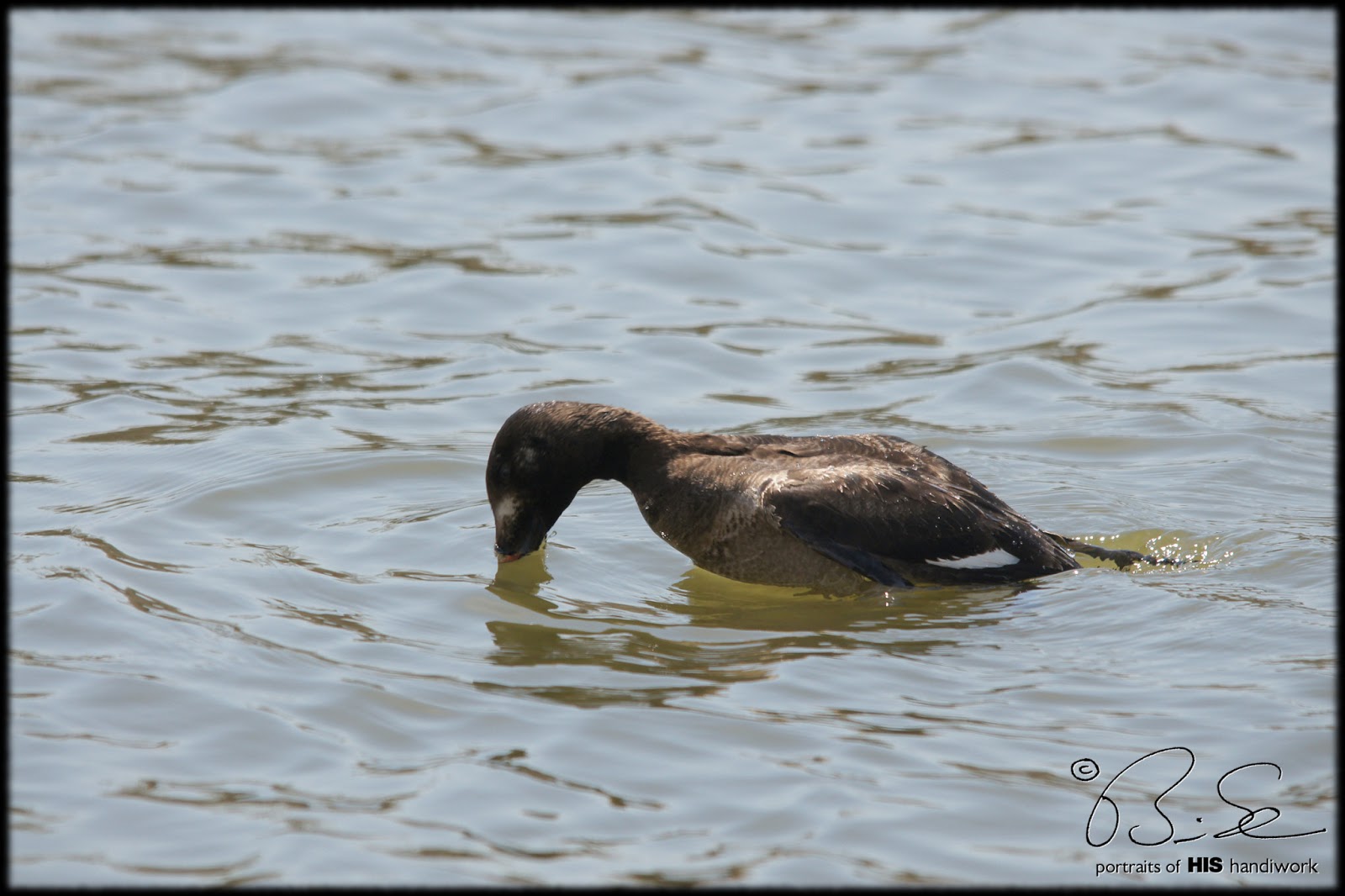
Last spring in February, at almost exactly the same location, I discovered my first White-winged Scoter.  This year, it was definitely not my first of the year, but I spotted a lone bird sleeping, bobbing in the gentle waves, not an apparent care evidenced by its bill tucked under a wing.  Once it had drifted close enough to the shore, it stretched and went to finding lunch of mussels and crustaceans along the water bottom.

White-winged Scoter

White-winged Scoter dive.

Standing on the armourstone blocks that edge the water, I could clearly see it swimming, hunting with great speed through the boulders and obstacles in the water just ahead of me only meters away. Then he would pop to the surface and crunch the foraged mussel or captured crayfish and swallow it shells and all.  They have powerful mussels in their crop which break up the shells of their meal and they break down and then digest the tough meals.


White-winged Scoter eating Crayfish.

White-winged Scoter eating mussel.

Keep enjoying HIS handiwork!

Saturday, September 8, 2012

Not All Detours are Bad

This summer my route to work has been lengthened with two detours.  As frustrating as they can be, both have turned out to benefit me with seeing birds up close.


But first, during a site visit for work out in Campbellville I saw a few opportunities for a few photographs.  I had my camera along to take site photos of a development I had to provide entrance designs for, so was able to take a few photos near the site and on the way back to the office.  A pair of Barn Swallows were preening over Campbellville Pond in the morning light.  Unfortunately the sun was shining from across the pond so the lighting was hard to work with.

Barn Swallows

Some turtles were sunning on a log.  They must have very good eye sight because it is hard to get close without them slipping quickly into the water.

A pair of turtles sunning with one thinking about it.

Honey Bees on Purple Loosestrife
Female American Goldfinch
hiding in the Chickweed

A Trumpeter Swan was preening on a floating log.  It was tagged, so I submitted a bird encounter report.  I haven't heard anything back, and may never get a response.  The number on the metal band on its right leg would have given them more specific information than just the wing tag.  That obviously wasn't going to happen.  I didn't think Trumpeter Swans usually stayed around this area during the middle of summer.  Hopefully I get some sort of response.

Trumpeter Swan with wing tag.

On my way back to the office there were a few Wild Turkeys on the far side of a harvested wheat field.  When I stopped and got out, only one turkey remained for a picture.  Either it was smart enough to know I didn't have a gun, or it will be the one the hunters get during Turkey season.

Wild Turkey

From Wild Turkeys, to Turkey Vultures... As mentioned earlier, my detoured route to work has taken me down Old Guelph Road on the East border of Dundas.  One morning, a number of Turkey Vultures were roosted on a hydro tower, preparing for a day of soaring.

Turkey Vulture

Turkey Vultures are not the most attractive birds, their featherless heads giving them a rather unappealing look.  However, they are a bird with many specifically designed characteristics.  Their heads and most of their necks are featherless to minimize the affect of reaching inside dead bodies for tasty treats to eat.  They have an incredible sense of smell enabling them to detect the odour of dead animals before their more mediocre sense of sight locates them.  This is because they can detect this odours at concentrations of as low as just a few part per trillion (AllAboutBirds.org). This sense of smell is sometimes used by officials with trained birds to detect natural gas leaks.   Turkey vultures have amazing digestive systems.  In order to eating decaying animals and to be able to overcome diseases and poisons which killed the animal in the first place, they have special stomach acids and bacteria which will destroy those toxins.

Turkey Vulture

On my continued progress back to work from my field visit mentioned earlier, my route took me along the same detour of Old Guelph road.  At one point right in front of me, a Red-tailed Hawk launched off of a hydro pole and swept down into the long grass in pursuit of some prey.  I pulled over quickly and grabbed my camera (which was unusually with me and at the ready).  As I was stepping out of the car, the bird landed on a hydro pole right across the road.  It must have been preoccupied with its failed operation because it didn't notice me at first. I was hardly 15m away.

Red-tailed Hawk

I was hesitant to even move to raise my camera for fear that it would notice me, but with a slow and steady movement I lifted it and got off a few shots before it did look straight at me for a moment, and then flew off. As it left, it cried out loudly to another Red-tail which must have been perched nearby and they headed out together for the protection of the trees in the distance. A beautiful bird!!

Red-tailed Hawk

On my continued way into the office, (lunch time by this time) I quickly stopped at the York Street bridge which goes over two railroads and the waterway link (a remnant of the old DesJardins Canal) between Coote's Paradise and Hamilton Harbour. In Coote's Paradise, a large group of Double-crested Cormorants were feeding, then lifting off, circling to gain elevation and crossing over at the bridge to spend time in the harbour.

Hundreds of Double-crested Cormorants in Coote's Paradise

Double-crested Cormorant in flight.

Double-crested Cormorant flying over York Street bridge.

Double-crested Cormorant approaching the bridge.

While waiting for the next cormorant to approach, I spotted a dragon fly facing into the wind.  I wonder if it was using the breeze coming from Coote's to blow bugs towards it and just waiting their to snag them as they blew by.  Hard to photograph though - it hovered, but never long in one place and it's a small object focus on zoomed way in.

Hovering Dragonfly.

I popped down the long set of stairs and walked a short bit towards Bayfront Park.  A small man made island off the shore in the Harbour was full of sunning cormorants.

Double-crested Cormorants sunning.

A juvenile Black-crowned Night Heron was perched up in a Willow hanging over the water, and a lone Mute Swan was bathing and preening its feathers, while a two Opsrey were noisily calling as their wheeled about in the air overhead.  

Juvenile Black-crowned Night Heron

Mute Swan

Osprey

I still chuckle now as I write this.  There was a couple standing beside me exclaiming at how nice the spot was and something to the effect that it was nice to see wildlife around.  I was able to point the Night Heron out to them and tell the the name, just as some Caspian Terns flew round the bend.  Moments later the Osprey noisily appeared, and I'm pretty sure a cormorant surfaced pretty close by.  I can't remember if there was anything else, but I could point out some interesting birds, all literally within a few minute's time span.  It was almost comical.  The couple was very appreciative and it was very rewarding to be able to look back and realize that within a short time, I've learned quite a few birds by name and can share it with others to add to their enjoyment of an afternoon out for a walk.

Just before I left, a Turkey Vulture made a teetering glide just overhead as it crossed the ridge of York Road.  A nice finish to a detoured drive into work.


Turkey Vulture in flight.