Showing posts with label life bird. Show all posts

Tuesday, June 11, 2013

Ignoring Close to Home

It's weird that somehow it always seems more exciting to try and bird somewhere a distance away from your own backyard. And although birding in the Hamilton area is well documented to be very productive, it doesn't mean there is nothing close to home to see and enjoy. Over the last few weeks there have been more than one occasion for that to be true.  There was my recent trip to a nearby farm which started as a firewood acquisition.  And the next opportunity also resulted because of getting more firewood.

I was on the south side of St. George cutting and lugging home a few cords from a huge, old Beech tree which the hydro company had taken down in a big wire protection campaign they did in the area.  While feeding the thirsty chainsaw or filling the trailer with wood, consistently I was hearing a persistent, unfamiliar bird call.  On my last load, I brought the camera with me and decided to push into the neighbouring woods which also backs on to an adjacent golf course.  But before I could circle in on the source, I heard and then spotted a Eastern Wood-Pewee.  Their distinctive "PEE-ah-WEE" call gives them away, but they are small and like the tree tops, so I've not gotten a close look before. This one seemed curious about me, so although not really close, I could get a nice look and some closer shots.

Eastern Wood-Pewee

Eastern Wood-Pewee

Ironically, my circling in on the original singer lead me back to where I started, and I finally found the little creature who had been singing along with my chainsaw all day.  It was a cute little House Wren (life bird #124 - I skipped this one).  Unfortunately my vantage of the bird was through other underbrush and I couldn't seem to get a good angle, so I had to switch to manual focus and in low light, that didn't prove to result in many good pictures that were in focus.

House Wren

One other sight I spotted was a thoroughly tapped Pine tree by a Sapsucker.  I had "borrowed" and posted a photo from another website previously when I saw my first Yellow-bellied Sapsucker, but now I have my own picture to share.


Yellow-bellied Sapsucker food site.

Again close to home, there is an old sewage lagoon from the old Carnation condense milk plant in St. George which has since been closed.  And the sewage lagoon has also been decommissioned and reduced to a small fraction of its original size.  They basically excavated a big outlet in the original banks they had constructed years ago and left a shallow area of water to remain.  The location was still suitable for a small group of about 10 Canada Geese, and a little mixed flock of shore birds.  About three or four Spotted Sandpipers were courting each other and wading along the water's edge.


Spotted Sandpiper
 
Spotted Sandpiper courting "chase"

There was also a small group of four Killdeer there, and they seemed to be very busy with a prolonged argument.  If it's possible to tell male and female, I certainly don't know, so I'm not sure if this was a territory or mating battle, but the four would all slowly approach on each other and then one would make an aggressive move on one of the other in the group and they'd all wing a short retreat back.  It was repeated over an over again.

Killdeer
  
Killdeer standoff

The next few pictures have been quite a mystery to me.  A few of you received emails from me asking for your advice.

Sanderling? female Semipalmated (l) and Least Sandpiper (r)
The bird on the right I'm confident is a Least Sandpiper.  The yellow legs, size, etc all clearly point to that ID.  But the bird on the left is another story.

Sanderling? female Semipalmated Sandpiper (l) and Least Sandipiper (r)


At first, I thought I had a Semipalmated Sandiper.  But the beak seemed too long, and too pointed.  Some of you suggested Western (I try not to get myself excited about rare finds, of which that would be for this area) so I didn't really consider it.White-rumped was also considered but discounted because the wings don't seem to pass the tail really.  I was leaning to a juvenile Western though after lots of looking on the web.  For good measure I thought I'd ask the Hamilton Birders Group, and it seems the consensus is that it's a juvenile or female Sanderling.  That does seem to fit best and be most likely, though I still feel like the beak looks to long.  So, to be conservative, I'll stick with that ID and forgo an exciting new life bird tick.

Sanderling? female Semipalmated Sandpiper searching for food on the water bottom.

Thanks to everyone (Dwayne, Peter, Caleb, Wayne, Gerry) for their input.  Although somewhat frustrating not being able to come out with a clear ID, I think I learned a number of "peep" traits that hopefully will help in IDing them better in the future.


UPDATE: I received an email this morning from Kevin McLaughlin (who I understand is more than qualified on peeps) that female Semipalmated Sandpipers are known to have beaks that are almost as long as the Western Sandpipers.  So, based on that new information, I think I have a firm ID and learned something new in the process.  Thanks Kevin.

And, the moral of this post is, don't ignore the little spots close to home... there's likely more bird life hanging out there than you might think, even if it doesn't seem so exotic to burn gas getting to somewhere "else".

Keep enjoying His handiwork!

Sunday, June 2, 2013

Savannah Sparrow and Virginia Rail

Two weeks ago I headed out for a Sunday afternoon visit to Grass Lake.  The plan was to enjoy some close opportunities with the Osprey pair there and see if the Sandhill Cranes were still nesting in the same spot after hearing some crazy photographer hip-waded directly to the nest!

But when I arrived, the Osprey nest was a big pile of scattered branches and corn stalks on the road. Apparently a couple nights before, a big storm had blown it right off the supporting hydro wire wood braces.  I felt sorry for the bird pair, but they were "silly" not to have used a sturdy nesting box which had been put there this winter for them.  Realizing of course that they don't "think" like we do, you do wonder what made them think the much more precarious location they used was better. 

But, in the same location, I noticed a "little brown jobby" (an affectionate term for the many sparrows and other small birds that look alike from a distance) that appeared somewhat different.  It was not shy and allowed me to get quite close, and even continued with its interesting song.  I almost dismissed it as the very common Song Sparrow, but soon I noticed a yellow flash above the eyes.  It was a Savannah Sparrow and a life bird (#124).  It's a grassland sparrow and shares the habitat in that area with the Bobolinks, Eastern Meadowlarks, and other grassland sparrows that I have yet to see there.

Savannah Sparrow

In the same area, Horned Larks were traveling back and forth between a farmer's field and the protection of the grasses of the antenna field.  A stop on the road seemed part of their little routine too.  Not sure why as I can't imagine there was anything like salt from the winter to entice them.  There forays into the grasses would often start a squabble with a larger Bobolink that would attempt to guard its territory.


Horned Larks

I'm pretty sure this next picture is a juvenile Horned Lark.  I know Robin fledglings are out already, but I wasn't expecting to see young from other birds yet.  I guess at first I as just hoping it was another rare bird to get excited about, but I think my assumption on the juvenile Horned Lark is right.  I'll be glad to be proven wrong.

juvenile Horned Lark

This Bobolink kept coming back to one of two small saplings to sing away its claim to a certain area of the thick wild grasses.

male Bobolink

male Bobolink near nest?

This male seems to have a beak deformation of some sort.  Or, it lacks some personal hygiene.  I did a bit of research, but it seems that naturalists are completely sure what causes different beak abnormalities, aside from assumptions that there may be nutrition issues, or simply an abnormality from birth.  The defect seems to affect birds of all strips... here's a link to a collection of many different birds with the sad fate.  For many, it will mean a short and/or difficult life.


I headed out to Grass Lake for the reminder of my visit time, to see if anyone could give me an update on the Cranes and their nesting/eggs status.  Just as I arrived a few of the Cranes flew in along the north side of the lake.  No one really knew the status of the nest or if any eggs were being tended.  The last nest site I had seen was well hidden in last year's cat tails, so I'm not sure anyone will know if they are still using this location until, hopefully, some young colts are walking around.


Sandhill Crane landing

Another man with a few other photographers were working to call out some Virgina Rail they had heard.  I'm not adverse to using bird calls if it's done respectfully (of the birds and other birders/photographers) but, I'm afraid this guy was beyond anything I've seen before.  He had it on repeat and would simply flick on his little speaker and let it play for minutes on end at full blast.  We were at the top of the road embankment, and he along with some other photographers seemed of the opinion the birds would walk up the steep hill to them for a posed picture.... maybe I'm too unfamiliar with this bird, but I don't think so! 

Virginia Rail hiding

I decided to head down the embankment, partially to avoid the audio assault, but to see if some good old looking and quiet "hunting" would pay off.  It did!!  They are extremely hard to find and see, but I finally spotted one.  Now photographing them is completely another story!!  You can forget auto focus - trying to shoot into the thick grasses they like to hide in and expecting .  So the shots I got were hard fought, and topped of by the fact that they were of life bird #125!


Virginia Rail

 Till next time... Keep enjoying His handiwork!

Saturday, June 1, 2013

Two Nests and Two Life Birds

A little bit back, I saw activity on the bird boards that there were some American White Pelicans in the area and that they had recently moved to Coote's Paradise and were spending time on a sandbar of one of the small islands there in the mornings.  I decided to head into work early to see if they could be sighted.  It didn't take a second glance to confirm they were their.  They are huge, and their size and pure white plumage stood out in stark contrast to the cormorants that were making their company.  I had no close access, so had to make due with a tripod shot from on on the ridge that York Road follows.  These shots are quite cropped, but definitely show the dark flight feather markings of the bird landing. An exciting life bird (#122).


American White Pelicans with Double-crested Cormorants in Coote's Paradise

American White Pelicans

That lunch hour I headed to Valley Inn Road, and headed down the Grindstone Trail.  The songs of many birds filled the air and the distinctive sweet sound of the Yellow Warbler belied its location for a brief picture.  Interesting how birds will still sing even while preening.  I guess that's a lesson in doing your work with cheer!


Yellow Warbler preening

As I headed further down the trail I was met with another flurry of yellow, but darker, larger, and mixed with black. Three Baltimore Orioles were loudly dueling over territory, and later, I discovered a nest right in that vicinity, so one male was courageously dealing with two trespassing intruders.


 Baltimore Oriole nest - way up in the top of a big Poplar Tree


male Baltimore Oriole
 
female Baltimore Oriole

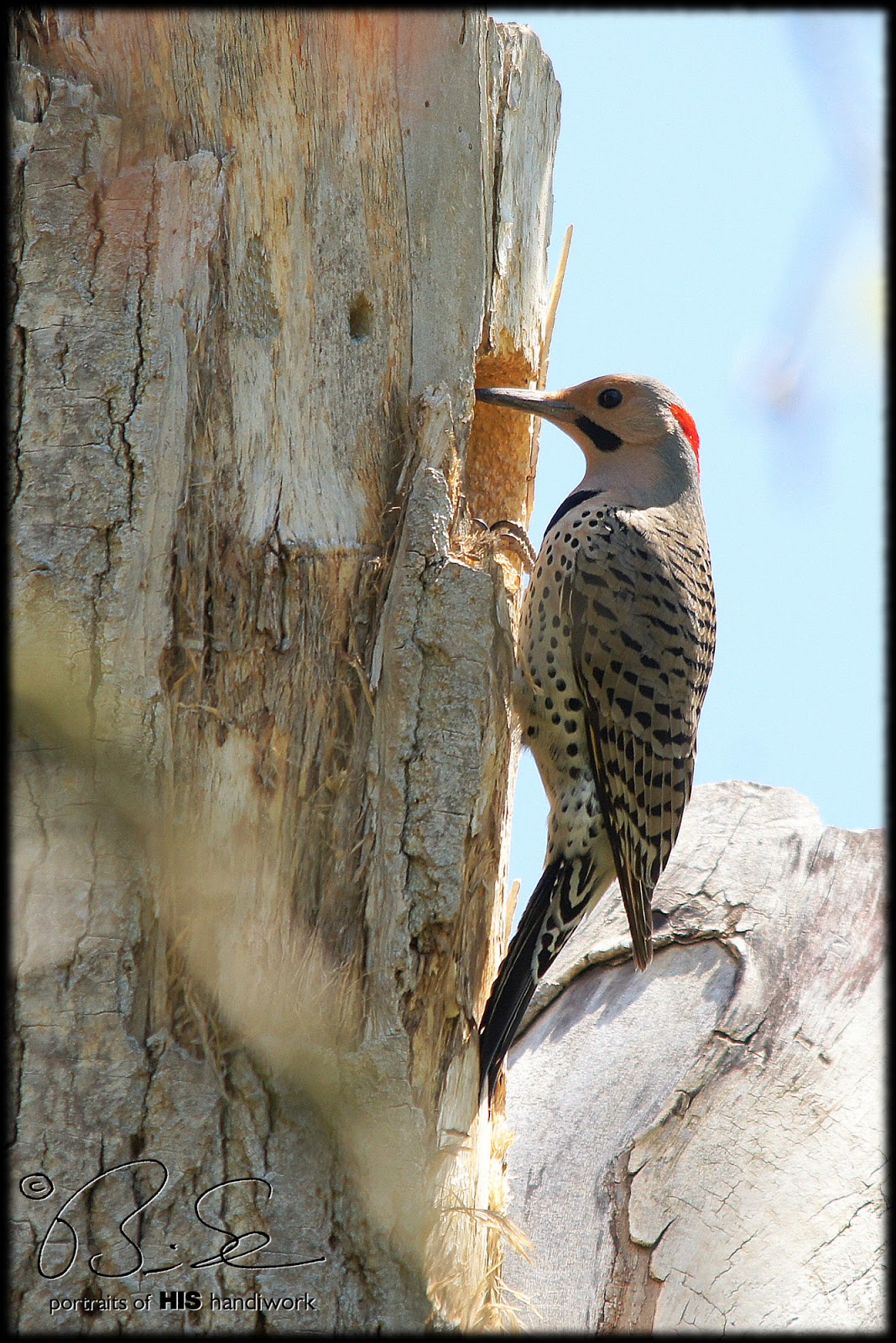
Further down the path, I startled two Northern Flickers off a dead snag, and with a second look, noticed that there was a freshly chiseled opening.  Biding my time, I settled in for a wait, and sure enough, one returned to what was confirmed as a nest.  Inside he popped, promptly checking on whatever was inside.

Northern Flicker nest entry

Northern Flicker
Northern Flicker
Northern Flicker

 After tolerating my presence for a while, suddenly the bird became quite agitated, squawking and looking down below.  I wasn't sure why, but soon it left and I saw the reasons... a Red-bellied Woodpecker pair were on the same tree, and a flurry of chasing began.  It was too fast to try and get any pictures and not one even caught anything.


Protesting the visitors

Notice the Red-belly on the bottom of the picture
and the Flicker at the top.


male Red-bellied Woodpecker
Strangely, it all seemed to end quite quickly, and the male Red-belly remained to feed on a tree just next to the snag with the nest.  It was quite unconcerned with me.

Red-bellied Woodpeckers were given the wrong name in my opinion, given the inconspicuously small patch of slightly red belly they do have.  Others have written the same and I agree with one writer who thought they should have been called "Ladder-back Woodecker".  You can see why in the picture above.


male Red-bellied Woodpecker feeding on ants from a branch hole.

male Red-bellied Woodpecker feeding

Hoping not to belabour the Flicker pictures, I got a couple pictures with the bird blinking. Woodpeckers have a number of significant design features which are all necessary for it to survive its interesting habit of whacking its head on trees (see a previous post about this here about this bird's design features).  One thing they need is strong eyelids to protect and keep their eyes from popping out of their sockets as their head stops with the impact.

Thick, protective eyelids.


I was met by a nice lady who had just spent an hour just around the corner trying to photograph Kingfishers which I had heard noisily rattling away from up the creek while I was at the Flicker nest.  When she came by, I kindly pointed out the Pileated nest.  She got very excited but couldn't seem to spot the nest hole I was pointing her to.  Seems, I had, as I wrote above, mis-spoken. Oops, not a Pileated, a Flicker nest.  Then I understood her excitement and the fact that she could not spot the very large hole that would be present had it been a Pileated Woodpecker nest!  I subtly tried to regain some of my reputation and hoped I could assure her that, although not an expert, I did know what I was talking about. Susan posts some very nice pictures here.  Sorry for disappointing you Susan!

And if I'm honest, I think I was also pointing out following Orchard Orioles (the pictures above), though it obviously turns out that Orchard Orioles are much more of a dark, almost chestnut colour.  Boy, did I ever eat humble pie that day!

In the same area as the Flickers, there was a pair of tiny Blue-gray Gnatchatchers busily harvesting tiny bugs from a flowering Pin Cherry tree.  They are such tiny, cute birds.


Blue-gray Gnatcatcher

Blue-gray Gnatcatcher - funny look

On my way back to the car, another pair of small birds caught my attention as they flitted about in the trees... They didn't stay long, but I got enough distant pictures for Peter and Caleb Scholtens to help me ID it later on as a Warbling Vireo.  (life bird #123) 2nd of the day!


Warbling Vireo

Just across from the parking lot, this adult Racoon was out in the middle of the afternoon, an odd time for this generally nocturnal animal.  Made for a nice picture though!


Racoon in broad daylight.

More life birds and good times still to post....
Keep enjoying His handiwork!!


Monday, October 1, 2012

The Big "100"


As mentioned in my last post, I spent a few mornings at the mud flats of Coote's Paradise off the east side of Princess Point created by the lack of rainfall from the very dry summer and fall.  I waited for the golden glow of the early sun's rays to come over the tree tops.  With the slow advance of the edge of light, mud and water and shore birds became light enough for photographing.

Well, I hit the 100 mark on my birding life list!  Though not anywhere close to the huge count of Josh Vandermeulen who is currently doing an Ontario big year (At the time of this post, his blog reports he sits at 331, and we are all hoping he can surpass the record of 338.) I'm still pretty pleased with my 100th bird on my list.  At first I had not planned to do the list thing, but somehow it just happens as you start to tally what you have seen so far.  I'll introduce bird 98, 99, and 100 in order, all shore birds.

The first shore bird was from a group of Lesser Yellow Legs, wading in the soft mud hunting for small creatures living there.  These birds breed in Northern Canada and have pretty much finished their migrating pass through our area on their way south, mostly to South America.

Lesser Yellowlegs arriving.

Lesser Yellowlegs wing stretch.

Lesser Yellowlegs

Lesser Yellowlegs and turtle.

The next shore bird I found were a group of Least Sandpipers wading along the eastern shore just off the recreation trail which links with Bay Front Park.  They are the smallest of the Sandpipers (often called Peeps).

Trio of Least Sandpipers
My 100th life bird happened by accident really.  I was taking pictures of the Least Sandpipers and saw this bird up closer and snapped some shots thinking it was a more brave bird of that group.  But when editing, I noticed the markings seemed different.  To tell you the truth, I didn't even know what the Least Sandpipers were till after receiving some help from some other birding/blogging friends Caleb and Dwayne - thanks!  I have to admit that for the most part, many of the shorebirds all looking very similar and hard to clearly distinguish.  I'm sure if saw them more often and was routinely IDing them, that would change, but that is not likely to happen. For now anyways, the key to IDng the Least Sandpipers is their yellow legs.

Life Bird #100 - Semipalmated Sandpiper

A song sparrow was also foraging, resting the drier mud portions for bugs and other food.  Some Mallard ducks were preening across the water.

Song Sparrow
Female Mallard Ducks preening.

A Great Blue Heron seemed to be waking from what may have been its roost for the night.  I think they usually will roost in trees, but this may have been a safe spot for the night.  It was definitely going through a thorough stretch routine of each leg, wing, neck... That neck of theirs is quite something.  All herons have very long necks, and they seem to have a couple of hinge points allowing them collapse quite compactly.  I search on the net quite a bit and didn't find anything specific about it.  Notable is that herons do this, but cranes and geese fly with their necks fully extended.

Great Blue Heron waking up.
Great Blue Heron wing stretch.
Great Blue Heron neck stretch.

On the way back to the car, heading back to work, I had to try and capture these sights... the dew was heavy on the huge number of spider's webs all over the golden rod and other brush.

Morning dew on a spider web.
Spider

On the way home that night, I saw quite a few birds and stopped making me quite late for supper.  Some how, at the moment it seem perfectly logical that a stop is justified and that it will only take a couple minutes.  I don't often have the camera in the car on the ready, so this time I didn't resist.

I stopped first at a bridge on Hwy 5 which crosses Spencer Creek where I very regularly see a Great Blue Heron  in the shallow waters.  I thought I'd try and sneak up on him.  I didn't work and I only got some blurry fleeing flight shots.  What I hadn't noticed was a Green Heron right on the shore, just in front of me, close to the bridge.  I was just about to leave and I must have finally scared it and it flew up into a tree a little ways off.  I have had similar things happen often, and I have to remember to look around more carefully after having seen one bird - often there are others.

Green Heron.

On my detoured route home, I drove past, turned around and shot this Red-tailed Hawk from my window before it grew too wary of me and flew off.  Further on my drive I repeated for a much larger Red-tail which was likely a female, being larger than the males.

Red-tailed Hawk

Red-tailed Hawk

I've noticed this set of woodpecker holes on a dead tree I pass every day to and from work.  I've seen a woodpecker right at the hole once during the summer, but as mentioned earlier, I rarely have the camera with me and am often on my way to work or just about home.

Woodpecker nest?
This time I stopped and noticed a dead Elm close by where there were a number of Red-bellied Woodpeckers flitting about from branch to branch along with a number of other birds.  There are 6 birds in the picture below, and at least four different birds.  If someone is really good at silhouette, they can fill me in on what they think the other birds are.

Can you find the 6 birds in this photo?  One is a Red-bellied Woodpecker.

Below is some help... I've received a few comments already on this one. :)

1. ???
2. Blue Jay
3. Mourning Dove
4. ???
5. ???
6. Red-bellied Woodpecker

Just down the road is Fairchild's Creek and again I almost snuck up on a Great Blue Heron.  A Belted Kingfisher chided me as well and stayed long enough for a distant photo.

Belted Kingfisher

I seem to have days where I get to see lots of birds all one after the other, and then other days when I see next to nothing.  Well, I'm still behind on posts, so there are more to come for the blog anyway.  One more blog post on the Princess Point area of Coote's Paradise to come, and then a post on a trip up to the Lodge again.  Fall is coming with the crisp air, full bodied clouds and blue skies, amazing colour display of the turning leaves.  Fall...my favourite season.